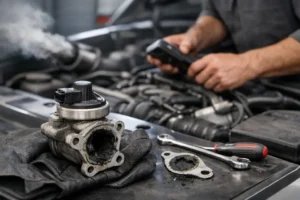
If your dashboard has suddenly lit up with an AdBlue warning, an engine management light, or a no-start countdown, you do not need a lecture on emissions systems – you need a proper answer. AdBlue fault repair Manchester drivers actually need starts with accurate diagnosis, because these faults are often misread, misquoted and, in plenty of cases, badly repaired.
That matters because an AdBlue issue is rarely just a warning message. Leave it too long and the car or van may drop into reduced performance, keep nagging with restart warnings, or eventually refuse to start at all. For anyone who relies on their vehicle for work, school runs or commuting, that quickly becomes more than an inconvenience.
Why AdBlue faults get expensive so quickly
Modern diesel vehicles are packed with emissions hardware designed to work together. The AdBlue system is there to reduce NOx emissions through the SCR system, using fluid injection, sensors, pumps, wiring and control logic. When one part of that chain stops behaving properly, the vehicle may log a fault even if the actual cause sits elsewhere.
This is where many owners get caught out. A dealer or general garage may jump straight to replacing a tank, pump or injector because a fault code points in that direction. Sometimes that is the right fix. Sometimes it is not. Fault codes are a starting point, not a diagnosis.
A vehicle can show AdBlue errors because of contaminated fluid, a failing pump, level sensor faults, injector crystallisation, poor electrical connections, battery voltage problems or software-related issues inside the control strategy. If the wrong part gets fitted first, the bill rises and the original problem is still there.
Common signs you need AdBlue fault repair in Manchester
Some warnings are obvious, others are easy to ignore until the vehicle forces the issue. The most common signs include an AdBlue warning light, messages telling you to refill AdBlue when the tank is not actually empty, repeated engine management lights, and a countdown showing limited miles before restart is blocked.
You might also notice poor performance, the van refusing to clear warnings after topping up fluid, or faults coming back shortly after a previous repair. In colder weather, some systems become even more temperamental, especially where heaters or wiring are involved.
For working vans and diesel family cars, the no-start countdown is usually the point where the problem becomes urgent. At that stage, guessing is the expensive option.
What causes AdBlue system faults?
Sensor and level reading problems
One of the most common issues is the car believing the AdBlue level is wrong. The tank might contain enough fluid, but a sensor fault or internal tank issue tells the ECU otherwise. The driver sees a refill message, tops it up, and nothing changes.
Pump and pressure faults
The system relies on pressure being generated and controlled properly. If the pump weakens or pressure readings fall outside expected values, the vehicle may log an SCR fault and trigger warnings. These faults can be intermittent at first, which is why some vehicles behave normally one day and complain the next.
Injector blockages and crystallisation
AdBlue can crystallise, particularly around the injector or dosing valve area. Once that happens, the flow can be restricted and the system no longer doses correctly. That can set off efficiency faults or repeated warning messages.
Wiring and control issues
Not every AdBlue fault is a failed mechanical component. Damaged wiring, corroded plugs and voltage irregularities can all upset the system. On some vehicles, software behaviour or stored adaptations also play a part, especially after previous repair attempts.
Why proper diagnosis matters more than a quick reset
A lot of people search for someone to simply clear the warning light. That can be tempting if the vehicle still drives and you just want the message gone. The trouble is, resets without diagnosis usually do not last. If the root fault remains, the same warning comes back, often at the worst possible time.
Good diagnosis means checking live data, fault history, system behaviour and the real condition of related components. It means separating a genuine hardware failure from a false reading, a software issue or a wiring problem. That is how you avoid paying for parts you did not need.
This is especially important if you have already had one unsuccessful repair. By the time a second or third garage gets involved, owners are often frustrated, out of pocket and still staring at the same countdown on the dash.
Repair or software solution – which is right?
This depends on the vehicle, the fault and the owner’s priorities. In some cases, a physical repair is clearly the right path. If there is an identifiable issue with wiring, an injector, a pump or contamination, sorting that fault properly makes sense.
In other cases, software-based AdBlue solutions are considered where repeated system failures, very high replacement costs or known design weaknesses make conventional repair poor value. That is not about guesswork or a quick patch. It needs to be handled by someone who understands the platform, the control system and the practical implications for the vehicle.
The honest answer is that there is no one-size-fits-all fix. Anyone promising the same answer for every make and model is oversimplifying the job.
Why mobile AdBlue fault repair makes sense
For many owners, the problem is not only the warning light. It is the lost time. Taking a van off the road, arranging transport to a garage, waiting for updates and then being told more parts are needed is a poor setup if you use your vehicle to earn a living.
A mobile specialist can diagnose and resolve many AdBlue faults at your home or workplace, which cuts out a lot of wasted time. That practical side matters more than people sometimes realise. If your van is parked on a drive in Rochdale, outside a job in Salford or at home after work in Stockport, being able to deal with the issue there and then is a genuine advantage.
It also helps to know who is actually doing the work. Owners are rightly wary of booking through a polished website or phone line only to find the job passed on to someone else. When the fault is technical and the vehicle is essential, direct service from the specialist matters.
Choosing the right specialist for AdBlue fault repair Manchester
Not every garage that services diesels is an AdBlue specialist. There is a difference between reading codes and understanding how these systems fail in the real world.
Look for experience with diesel emissions systems specifically, not just general diagnostics. Ask whether the diagnosis comes before quoting for major parts. Ask whether the work is guaranteed. Ask whether they regularly deal with no-start countdowns, recurring SCR faults and previous failed repairs.
You also want plain speaking. A good specialist should be able to explain the likely cause in clear terms, tell you what can be tested, and be upfront if there are options rather than one fixed answer. That honest approach is often what separates a proper operator from someone selling expensive guesswork.
TechTuning Northwest has built its reputation on that kind of straight, hands-on service – diagnosing the fault properly, carrying out the work directly, and helping drivers get back on the road without the usual runaround.
What to do if your AdBlue warning has just appeared
Do not ignore it, and do not keep topping up fluid repeatedly unless the system genuinely needs it. Overfilling or using poor-quality fluid can create extra issues. If the warning has appeared alongside a countdown or engine management light, get it checked sooner rather than later.
If the vehicle still starts and drives, that is the best time to act. Once the countdown reaches zero, your options become more awkward and recovery may be needed. Taking action early usually gives you more choice and less cost.
It is also worth mentioning any recent work when booking diagnosis. Battery changes, DPF issues, sensor replacements and previous AdBlue repairs can all provide useful clues. The more accurate the picture, the faster the fault can be narrowed down.
A proper AdBlue fix is not about clearing a message and hoping for the best. It is about understanding why the system is complaining and choosing the remedy that actually fits the vehicle. If your diesel is warning now, dealing with it early usually means less stress, less downtime and a much better chance of sorting it properly first time.