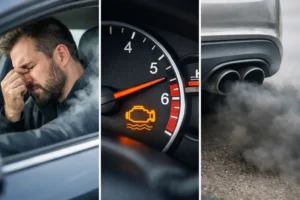
You plug in a diagnostic tool, clear the fault, top up the AdBlue, and still the warning behaves oddly. No mileage countdown appears, or it should have started by now but has not. If you are dealing with an AdBlue countdown not starting, that usually points to a fault in the SCR system logic, sensor feedback, or the way the ECU is interpreting the fault state – not simply a low-fluid issue.
That matters because a lot of drivers get told to start with the basics, then end up spending money on parts that do not fix the real problem. We see this regularly on diesel cars and vans where the dashboard message does not follow the normal pattern. Instead of giving a clear restart countdown, the vehicle may show an engine management light, emissions warning, or AdBlue fault message without moving into the expected no-start sequence.
What an AdBlue countdown not starting usually means
On most modern diesel vehicles with SCR, the countdown is there to force compliance once the system decides emissions control is no longer working properly. In simple terms, the car or van is designed to warn you, then eventually refuse to restart if the fault remains active. When the AdBlue countdown not starting becomes the issue, it often means the control unit has logged faults but has not yet met the exact conditions to trigger the final countdown stage.
That can happen for a few different reasons. Sometimes the fault is intermittent, so the ECU sees a problem but not consistently enough to trigger the next step. Sometimes the system has already been worked on badly, with partial resets or poor coding leaving the logic in an in-between state. On other vehicles, failed NOx sensors, pressure issues, injector faults, tank heater problems, or communication errors can all confuse the normal sequence.
The key point is this – no countdown does not mean no fault. In many cases, it means the fault is still there, but the vehicle is not following the clean textbook version of the warning process.
Why the warning sequence does not always behave normally
Drivers are often told that AdBlue faults are straightforward. Top it up, clear the code, drive it, and the warning should reset. That does happen sometimes, but not when there is a deeper system problem.
The SCR system relies on several components talking to each other properly. The ECU needs believable readings from sensors, proper dosing control, correct temperature data, and successful system checks. If one part is giving implausible information, the vehicle may store faults without launching the countdown you expect. In other words, the system can be faulty without being predictable.
This is where generic advice causes problems. A main dealer or general garage may recommend replacing the obvious failed part first. The trouble is that AdBlue systems are well known for chain-fault behaviour. One fault can trigger another, and one failed component can mask a second issue. You can easily spend a four-figure sum chasing the system round in circles.
Common causes behind an AdBlue countdown not starting
A failed NOx sensor is high on the list, especially on European diesel vehicles. These sensors are central to SCR monitoring, and when they drift or fail outright, the ECU may log emissions faults without behaving in a logical way on the dash.
AdBlue injector faults are also common. If the injector is blocked, leaking, or not dosing correctly, the system may detect poor SCR performance rather than a simple low-level condition. That can produce warnings which feel inconsistent to the driver.
Then there are tank and pump faults. Crystallisation, heater failure, pressure problems, and poor-quality fluid can all interfere with normal operation. On some vehicles, wiring and communication faults are just as likely as failed hardware. A corroded connector or damaged loom can create symptoms that look like a major system failure.
Software history matters too. If the vehicle has had previous repair attempts, coding changes, module replacements, or poor-quality delete work in the past, the warning logic can end up behaving strangely. That is one reason proper diagnosis matters more than guessing.
Can you still drive if the countdown has not started?
Maybe, but that is not the same as being in the clear. Some vehicles will continue running for quite a while with an active AdBlue fault and no visible restart countdown. Others can switch quite suddenly into a non-start warning once the ECU completes certain checks.
That is why waiting for the problem to become more obvious is not a good plan. If you depend on your vehicle for work, school runs, or daily commuting, the risk is not just the warning light. The real problem is uncertainty. You do not know whether the vehicle will behave the same tomorrow, next week, or after the next cold start.
If the warning has appeared more than once, or keeps returning after topping up and clearing codes, the system is not healthy. It needs proper attention, not another bottle of fluid and a hopeful reset.
Why replacing parts is not always the sensible answer
There are cases where a full repair route makes sense, especially on newer vehicles under warranty or where the owner wants the system returned to standard regardless of cost. But outside that, many owners are already past the point of economical repair by the time they start searching for answers.
A single NOx sensor can be expensive. Add labour, diagnostics, injector testing, tank issues, or another sensor fault that appears afterwards, and the bill climbs quickly. For an older diesel or a hard-worked van, that often makes little financial sense.
This is where honesty matters. If the system has become a repeat problem, it is fair to say that replacing parts may not be the best use of money. Some garages keep fitting components because that is the only route they offer. A specialist should tell you when the economics no longer stack up.
A practical option when the system keeps failing
For many owners, the sensible route is a full AdBlue system software operational file delete that removes the operating faults and countdown-related issues from the ECU calibration. That is not a physical repair of the AdBlue system, and it is important to be clear about that. We do not repair AdBlue systems. We provide a full software solution that removes AdBlue system operation along with the associated fault and countdown codes.
That approach suits drivers who have already had enough of repeat warnings, failed sensors, failed pumps, or inflated repair quotes. It is especially relevant when the vehicle is out of warranty and the cost of restoring the system properly is hard to justify.
The benefit is not just the warning light going away. It is about getting rid of the uncertainty around non-start logic, repeated dashboard messages, and ongoing SCR-related faults that interrupt the use of the vehicle.
When an AdBlue countdown not starting points to a bigger issue
If the countdown is not starting but the fault is active, that often means the vehicle is sitting in an unstable state. It may not be immobilised yet, but it is not healthy either. That can be more frustrating than a clear countdown because you are left guessing what happens next.
In real-world use, these are often the jobs that have already been to another garage first. The customer has had codes read, maybe a sensor mentioned, maybe a tank quoted, but no one has explained why the warning pattern makes no sense. Usually, the answer is simple – the system fault is real, but the vehicle is not following the ideal script.
That is why specialist knowledge matters. AdBlue faults are not difficult because the warning light is mysterious. They are difficult because the system logic is fussy, expensive, and easy to misread if you do not deal with these vehicles regularly.
Getting the right outcome
If your diesel car or van has an AdBlue warning but no proper restart countdown, treat it as a live issue. Do not assume the lack of countdown means the problem has gone away. And do not assume the first part someone suggests will solve it.
A proper specialist should be upfront with you about what the vehicle is doing, what the likely cause is, and whether a repair route is worth the spend. For many owners, especially those using their vehicle every day, a reliable software-based solution is the more practical answer when the SCR system has become a money pit.
At TechTuning Northwest, that is exactly how we approach it – straight advice, proper fault handling, and a solution that fits the reality of the vehicle rather than a workshop wish list. If your AdBlue warning is behaving oddly, act before it decides for you.