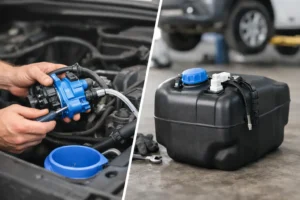
An SCR warning is rarely just an annoying dashboard message. On many diesel cars and vans, it can bring up an engine-management light, reduce power or start a countdown that eventually prevents the engine from restarting. Knowing how to fix SCR system faults starts with finding the actual failed component or condition – not fitting the first expensive part a fault-code reader mentions.
SCR faults are common on modern Euro 6 diesels from Peugeot, Citroën, Volkswagen Group, Mercedes-Benz, BMW, Ford, Renault, Vauxhall and others. The systems differ in layout, but they all rely on the same principle: dosing AdBlue into the exhaust so harmful nitrogen oxides are converted into less harmful gases. If the engine ECU cannot prove that process is working, it will log a fault and may restrict the vehicle.
What an SCR system fault actually means
SCR stands for Selective Catalytic Reduction. It uses an AdBlue tank, pump or supply module, heater, injector, pipework, NOx sensors and an SCR catalyst. The ECU monitors readings before and after the catalyst, calculates how much AdBlue should be injected, and checks whether emissions have reduced as expected.
A warning does not automatically mean the SCR catalyst has failed. It may mean the AdBlue level signal is implausible, the fluid quality reading is wrong, the tank heater has an electrical fault, a NOx sensor is reporting nonsense, or the injector is blocked by crystallised AdBlue. A wiring problem can produce the same warning as a failed sensor.
That distinction matters. Replacing a catalyst or complete AdBlue tank without proper testing can cost hundreds or thousands of pounds and still leave the original fault behind.
Start with the symptoms and warning messages
The exact wording on the dash gives useful context. Messages such as “AdBlue range”, “emissions fault”, “starting impossible in 700 miles” or “no engine start in X miles” should be taken seriously, particularly if the vehicle is used for work.
A countdown usually means the ECU has decided it cannot confirm the SCR system is operating correctly. Topping up AdBlue may help only when the level is genuinely low and the system has no other faults. If you have filled the tank and the warning remains, repeatedly adding more fluid is unlikely to solve it.
Other useful clues include a strong ammonia-like smell around the exhaust, white crystal deposits beneath the vehicle, poor fuel economy, reduced performance or a fault that returns shortly after being cleared. These symptoms help point a diagnostic in the right direction, but they are not proof on their own.
Read the fault codes properly before buying parts
The first practical step is a full diagnostic scan using equipment that can communicate with the engine ECU and, where fitted, the AdBlue control unit. Generic code readers can be useful, but they often give a broad description such as “SCR efficiency below threshold” without live data or manufacturer-specific test functions.
Common SCR-related codes include P20E8 for low reductant pressure, P204F for reductant system performance, P20EE for SCR efficiency, P2200 or P2202 for NOx sensor circuit faults, and P205B or P205C for AdBlue tank temperature sensor issues. Code definitions vary by manufacturer, so the number is a starting point rather than a diagnosis.
A good diagnostic checks when the code set, whether it is current or historic, freeze-frame data, live NOx readings, AdBlue pressure, calculated versus actual dosing values, tank temperature and battery voltage. It should also look for related engine, DPF and EGR faults. An SCR system cannot be assessed in isolation if the engine is producing excessive soot or its exhaust-temperature readings are wrong.
Do not clear codes simply to see if the light stays off. Clearing them can erase useful evidence, and a temporary clear does not repair a pressure fault, sensor fault or blocked injector.
Check the simple causes first
Use the correct AdBlue and inspect for contamination
AdBlue must meet ISO 22241 specification. It is not a fuel additive and must never be mixed with diesel, water or anything else. Contamination can damage components, trigger quality-related faults and lead to crystallisation.
Poor-quality fluid, old fluid stored in unsuitable conditions or contamination in the filler neck can all cause trouble. However, a dashboard warning after a refill does not automatically mean the AdBlue itself is bad. Some systems need a drive cycle, a successful self-test or a diagnostic reset after a genuine low-level event.
Look around the tank, lines and injector for white crystals. Small deposits can be normal over time, but heavy build-up often indicates a leak, a poor seal or injector deposits. Never attack electrical connectors or plastic components with aggressive chemicals.
Check voltage, fuses and wiring
Low battery voltage causes more emissions faults than many owners expect. Modern diesel ECUs are sensitive to voltage drops during starting, and weak batteries can create implausible sensor readings or communication faults.
A technician should check battery condition, charging voltage, fuses, earth points and the wiring loom to the NOx sensors, tank module and injector. Wiring near the exhaust is exposed to heat, water, road salt and damage from underneath the vehicle. On vans that cover high mileages or work on rough sites, this is especially worth checking before replacing sensors.
The faults that most often need repair
Failed NOx sensors
Most SCR-equipped diesels use one NOx sensor before the catalyst and one after it. Their readings tell the ECU whether the system is reducing emissions. When a sensor becomes slow, inaccurate or electrically faulty, the ECU can log an SCR efficiency fault even when the catalyst itself is sound.
A sensor may have an internal heater or communication fault, but live data is needed to identify which sensor is at fault. Replacing both by default is not always necessary. Equally, fitting cheap unbranded sensors can create repeat faults, because calibration and response time matter.
AdBlue pump, heater or tank module faults
The pump must build the required pressure and deliver fluid consistently. Tank modules often contain several parts together, such as a pump, level sensor, temperature sensor and heater. A fault in one element can lead to a repair quote for the entire module.
That may be justified on some vehicles where components are not separately available. On others, testing can identify a wiring issue, pressure problem or repairable fault before a complete tank assembly is ordered. The right route depends on the manufacturer, the fault code, access and parts availability.
Blocked AdBlue injector or crystallised pipework
AdBlue dries into crystals when it leaks or is exposed to heat. The injector at the exhaust can become restricted, and pipe connections may crystallise internally. The result may be low dosing, poor SCR efficiency or pressure faults.
The injector should be inspected and tested rather than replaced purely on suspicion. Cleaning may be possible where deposits are limited, but damaged injectors, contaminated lines and severe crystallisation can require replacement. The underlying reason for the deposits also needs addressing, otherwise the fault returns.
SCR catalyst efficiency faults
A P20EE-type efficiency code often makes owners fear the worst. Sometimes the catalyst has aged or become contaminated, particularly on high-mileage vehicles. But the ECU can also log the code because of a lazy NOx sensor, incorrect dosing, exhaust leaks, an injector fault, a DPF issue or an engine running problem.
This is why catalyst replacement should come late in the diagnostic process. Before condemning it, check sensor plausibility, dosing performance, exhaust integrity, engine faults and whether the vehicle has completed the conditions needed for the ECU to run its efficiency monitor.
Can you keep driving with an SCR fault?
It depends on the warning and how the vehicle is behaving. If there is no countdown, no power loss and no red warning, a short journey to arrange diagnosis may be reasonable. Leaving it for weeks is a gamble, because a minor warning can become a non-start condition after the ignition is switched off.
If a countdown is active, book diagnosis promptly and avoid unnecessary stops. Do not assume a motorway run will clear it. Unlike some DPF warnings, SCR faults are commonly caused by an electrical or dosing-system issue that driving harder will not repair.
When specialist diagnosis saves money
SCR systems need more than a code read and a parts catalogue. Proper diagnosis involves checking live values, electrical circuits, pressure operation, exhaust condition and manufacturer-specific procedures, then proving the repair with a road test or system test.
For drivers in Greater Manchester, Tech Tuning Northwest provides mobile diesel diagnostics for AdBlue, NOx sensor, DPF, EGR and ECU-related faults. That can be particularly useful when a van is on a start countdown or a car is difficult to move. The aim should be a clear explanation of what has failed, what needs repairing now and what does not.
If your vehicle has started an AdBlue countdown, treat the remaining mileage as time to diagnose the problem properly, not time to keep clearing the warning. A measured repair now is usually far less disruptive than a diesel that will not restart outside your home or on a job.