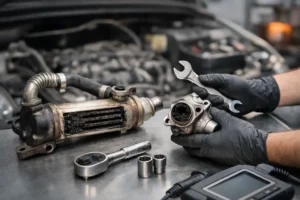
An AdBlue warning can quickly turn into a non-start countdown, which is why AdBlue repair vs replacement is not a question to guess at. One garage may recommend a complete tank assembly, while another may point to a sensor, wiring fault or software issue that can be resolved without replacing expensive parts. The right answer depends on the fault code, live data and the condition of the system – not simply the warning message on the dashboard.
For diesel drivers who rely on a car or van for work, a correct diagnosis can be the difference between a sensible repair and a four-figure bill for parts that were never needed.
What an AdBlue system actually does
AdBlue is a fluid injected into the exhaust system of many modern diesel vehicles. It works with the Selective Catalytic Reduction, or SCR, system to reduce harmful nitrogen oxide emissions. The vehicle monitors the amount and quality of AdBlue, the pressure in the delivery system, exhaust temperatures and readings from NOx sensors.
If one part of that chain reports an implausible value, the engine control unit can store a fault and display messages such as AdBlue system fault, emissions fault, starting impossible in 650 miles, or similar wording. The car may still drive normally at first, but ignoring it is risky. Once the countdown reaches zero, many vehicles will not restart until the underlying fault has been repaired and verified.
The dashboard message does not identify the failed component. That is where many AdBlue repairs go wrong.
AdBlue repair vs replacement: the real difference
A repair means identifying and correcting the specific cause of the fault. This might involve repairing damaged wiring, replacing a failed NOx sensor, cleaning crystallised fluid from a connector or injector, repairing a leak, correcting a software issue, or replacing an individual serviceable component.
Replacement usually means fitting a larger assembly, such as the AdBlue tank, pump module, heater unit, injector line or SCR catalyst. Sometimes that is the only proper option. Other times, it is suggested because a complete assembly is easier to quote for than carrying out detailed diagnostics.
Neither approach is automatically better. A genuine failed tank heater or internal pump cannot be fixed by clearing codes. Equally, replacing a tank will not cure a corroded wiring connection, an exhausted NOx sensor or a fault caused by incorrect data being received by the ECU.
When an AdBlue repair may be enough
Many faults are repairable when the main tank and pump assembly are still functioning correctly. Wiring faults are a common example, particularly where loom sections run beneath the vehicle and are exposed to water, road salt and vibration. A broken wire, high-resistance connection or water-contaminated plug can make a healthy component appear faulty.
Crystallisation can also cause trouble. AdBlue dries into white crystals, especially around the injector, pipework, filler area and electrical connectors. Minor crystallisation may be cleaned and the affected part resealed or refitted. If it has damaged the injector or blocked the line completely, replacement may still be needed.
NOx sensors are another frequent cause of SCR warnings. These sensors measure nitrogen oxide levels before and after the SCR catalyst, allowing the ECU to judge whether the system is working. They can fail internally, suffer wiring damage or send readings that drift out of range. Replacing the faulty sensor, followed by the correct reset and adaptation procedure where required, is often a far more targeted repair than changing larger AdBlue components.
Software and calibration issues can matter too. Some vehicles store faults following low-voltage events, poor previous repairs or failed regeneration-related issues elsewhere in the emissions system. Diagnostic work should establish whether the ECU is seeing a genuine mechanical failure before condemning parts.
When replacement is the sensible option
There are cases where repair is not reliable or cost-effective. An AdBlue tank with a failed internal pump, heater or level sensor may need replacement if those parts are built into a sealed unit and not separately available. This is common on a range of European diesel cars and vans, including models from Peugeot, Citroen, Volkswagen Group, Mercedes-Benz, BMW and Ford, although the exact layout varies by engine and model year.
A tank replacement may also be justified where internal crystallisation is severe, the pump cannot build or hold pressure, or the unit has developed an internal electrical fault. In these situations, cleaning the outside of the tank or repeatedly clearing the code will only delay the inevitable.
The AdBlue injector may need replacing if it is blocked, cracked or cannot deliver fluid correctly. Likewise, a damaged supply line, failed heater circuit or SCR catalyst that is no longer converting emissions effectively may require new parts. The key is having test results that support the decision.
A good technician should be able to explain what has failed, why it has failed and what tests rule out the other likely causes.
Why fault codes alone are not enough
Fault codes are useful starting points, but they are not a parts shopping list. A code may refer to low AdBlue pressure, heater performance, reductant quality, NOx sensor plausibility or SCR efficiency. Each can be caused by more than one issue.
For example, a low-pressure fault could be caused by a weak pump, a crystallised line, a leak, low fluid level, a wiring issue or poor voltage supply. A NOx-related code may be caused by the sensor itself, but it can also result from an AdBlue dosing problem or an SCR catalyst issue. Replacing the first component named by a generic scanner can become expensive very quickly.
Proper diagnosis looks at live data as well as stored codes. That includes AdBlue tank level, pump pressure, heater operation, dosing commands, sensor readings, battery voltage and whether the values make sense when compared with one another. Physical checks underneath the vehicle are just as valuable as scan-tool results.
The hidden cost of replacing parts too early
The largest expense is often not the price of the first part. It is paying for replacement after replacement while the original fault remains. A vehicle can have a new NOx sensor, then an AdBlue tank, then an injector, only for the warning to return because the wiring loom or ECU communication issue was missed.
There is also the inconvenience. Many AdBlue components require programming, resets, priming procedures or road tests after fitting. If the non-start counter is active, the vehicle may need the repair completed and confirmed before the countdown can be removed. Rushing the job or using unsuitable diagnostic equipment can leave the driver with the same warning and less money in their pocket.
What to do when the warning first appears
Do not keep topping up AdBlue unless the vehicle has actually indicated a low level. Overfilling does not repair a system fault and can create extra mess around the filler neck. Use only correct AdBlue fluid, keep the cap area clean and avoid allowing contaminated fluid into the tank.
Take note of the exact dashboard wording and whether a mileage countdown is displayed. If possible, arrange diagnosis before the countdown becomes critical. Continued driving is not always harmful in the short term, but it can leave you stranded once the vehicle is switched off.
Avoid anyone who suggests simply deleting or bypassing the emissions system. The SCR system must remain operational for the vehicle to meet its road-use and emissions requirements. The proper route is to identify the defect and repair it correctly.
Choosing the right repair route
Before approving an expensive AdBlue tank or SCR replacement, ask what evidence supports it. You should expect a clear explanation of the stored codes, live readings, electrical checks and physical inspection. If a component has failed internally, replacement is often the right decision. If the evidence points to wiring, crystallisation, a sensor or control issue, a targeted repair may save substantial cost.
For drivers across Greater Manchester dealing with an AdBlue countdown or recurring emissions warning, Tech Tuning Northwest carries out specialist diesel diagnostics at home or work where practical. The focus should always be on proving the fault first, then recommending the repair that genuinely fixes it.
An AdBlue warning is frustrating, but it does not automatically mean a complete new system. Get the cause established while the vehicle can still be driven, and you are far more likely to spend money on the right fix the first time.