A diesel that has suddenly lost power, started smoking or brought up an engine warning light can leave you expecting an expensive repair. EGR faults are a common reason for all three, particularly on cars and vans that spend much of their time on short local journeys. The important part is not to assume the EGR valve itself needs replacing before the system has been properly checked.
EGR stands for Exhaust Gas Recirculation. It is a system fitted to most modern diesel engines to reduce harmful NOx emissions. When it works properly, it is largely unnoticed. When it does not, it can affect how the engine starts, idles, pulls under load and regenerates its DPF.
What an EGR valve actually does
The EGR system takes a controlled amount of exhaust gas and feeds it back into the engine intake under certain driving conditions. This lowers combustion temperatures, helping to reduce NOx emissions.
The valve is normally closed when the engine needs clean air for strong acceleration, then opens at lighter loads when recirculation is required. On many newer diesels, there is also an EGR cooler, pipes, position sensors and electronic control built into the system. A fault can sit anywhere in that chain.
This is why a diagnostic code mentioning EGR does not automatically mean a failed valve. The ECU may have detected that the airflow or valve position is not where it expects it to be. A blocked intake, split vacuum pipe, faulty sensor, wiring issue or carbon-restricted cooler can produce a very similar result.
Common symptoms of EGR faults
Symptoms vary by vehicle and by whether the valve is stuck open, stuck closed or moving slowly. A valve stuck open can let too much exhaust gas into the intake, especially at idle or low speed. The engine may feel flat, hesitate when pulling away or run unevenly.
A valve stuck closed may not always feel as obvious from the driver’s seat, but it can trigger an engine management light because emissions are outside the expected range. Some vehicles will enter reduced-power mode to protect the engine and emissions system.
Typical signs include:
- Engine management light or emissions warning light
- Reduced power, hesitation or limp mode
- Rough idle, stalling or difficult starting
- Increased black smoke under acceleration
- Poorer fuel economy than usual
- DPF regeneration problems or a DPF warning light
- Cooling-system faults where an EGR cooler has leaked internally
Not every symptom will be present. A working van that mostly covers town routes may first show a DPF issue, while a motorway-driven car may only log an intermittent EGR position fault. The stored fault codes, live data and the way the vehicle behaves all matter.
Why EGR faults happen
Carbon contamination is the main cause. Diesel exhaust naturally carries soot, and the intake system also receives oily vapour through the engine breather system. Over time, this creates a sticky carbon deposit around the EGR valve, intake passages and EGR cooler.
Short journeys make this worse. The engine may not get hot enough for long enough to burn off moisture and deposits, while stop-start driving means the EGR valve is operating frequently. This is common on commuter cars, school-run vehicles and vans doing local deliveries around Greater Manchester.
However, carbon is not the only cause. Electronic EGR valves can suffer from failed motors, worn gears, damaged wiring or a faulty position sensor. Older vacuum-operated systems may have a perished vacuum hose, sticking solenoid or actuator problem. On water-cooled EGR systems, a leaking cooler can cause coolant loss, white exhaust smoke or contamination issues that need attention quickly.
A restricted DPF can also contribute. If the engine cannot complete successful regenerations, soot loading increases and the wider emissions system comes under more strain. Equally, an airflow meter, boost leak or intake flap fault can make the ECU believe the EGR system is not flowing correctly. Replacing parts without identifying that relationship is how bills start adding up.
EGR fault codes are a clue, not a diagnosis
Codes such as P0401, P0402, P0403, P0404 and P0405 are regularly associated with EGR faults, but their meaning needs interpreting in context. For example, P0401 usually points to insufficient EGR flow. That could be a blocked valve or cooler, but it could also be restricted intake passages, a vacuum fault or an incorrect airflow reading.
P0402 generally suggests excessive flow, often caused by a valve that is not closing properly. P0403 may indicate an electrical circuit fault, while P0404 often relates to valve performance or position range. Manufacturer-specific codes can provide more detail, particularly on BMW, Volkswagen Group, Mercedes, Ford, Vauxhall and Peugeot or Citroen diesels.
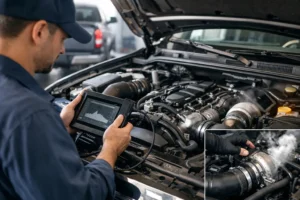
A basic code reader is useful for seeing why the warning light came on, but it cannot confirm which component has failed. Proper diagnosis involves checking fault-code history and freeze-frame data, looking at requested versus actual EGR position, comparing airflow readings and testing the wiring or vacuum control where appropriate. The intake and DPF condition may also need checking before a repair decision is made.
Can you drive with an EGR fault?
Sometimes the vehicle will remain driveable, but continuing to use it is not always the cheapest option. If the engine is in limp mode, struggling to accelerate or producing excessive smoke, avoid forcing it through long journeys or heavy loads. A van working under load can quickly turn a manageable fault into a DPF blockage or further intake contamination.
If there is coolant loss, white smoke, overheating or a strong sweet smell from the exhaust, stop driving and have the vehicle assessed. These signs can point to an EGR cooler problem rather than a straightforward dirty valve.
There is no fixed rule that a long motorway run will clear an EGR fault. A sustained drive may support DPF regeneration if the underlying conditions are right, but it will not repair failed electronics, damaged wiring or heavy carbon build-up. It can also be a poor gamble if the warning light is accompanied by reduced power.
Cleaning, repair or replacement?
The right repair depends on what has actually failed. If the valve is contaminated but mechanically sound, professional removal and cleaning can be a sensible option. It may also be necessary to clean related intake components, depending on the engine design and severity of deposits.
If the actuator, position sensor or valve mechanism has failed, replacement is normally more realistic. On some engines the EGR cooler and valve are supplied together, which affects cost. A quality replacement part and correct adaptation or calibration where required are more important than fitting the cheapest available component.
It is also worth addressing the reason the deposits built up. A DPF that is failing to regenerate, an injector issue, boost fault or poor airflow reading can lead to repeat EGR problems. Clearing the code after fitting a part is not proof that the repair has worked. The live readings need to return to normal and the vehicle should complete a proper road test.
Removing or disabling emissions equipment on a road-going vehicle is not a legitimate repair. It can create MOT, insurance and legal problems, as well as hiding the actual fault. A proper diagnosis gives you a repair route that keeps the vehicle operating as intended.
When specialist diagnosis saves money
EGR systems often get blamed because the code wording is simple and the part is familiar. In practice, they sit alongside the DPF, intake, boost control, sensors and ECU strategy. That is why an EGR-related warning light deserves more than a quick code clear or a guessed replacement.
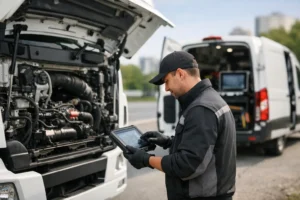
For diesel owners who rely on their car or van every day, a mobile diagnostic appointment can avoid losing time at a garage while still getting the fault checked properly. Tech Tuning Northwest diagnoses diesel emissions faults using live data and vehicle-specific testing, helping separate a genuinely failed EGR component from the faults that imitate one.
If your engine warning light has appeared once, do not wait until it becomes reduced power, a blocked DPF or a non-running vehicle. Getting clear answers early usually gives you more repair options and a better chance of keeping the bill under control.