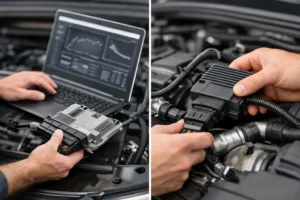
A NOx sensor fault can put a modern diesel into reduced power, trigger an engine warning light or start an AdBlue no-restart countdown. The expensive part is that a fault code naming the sensor does not automatically prove the sensor has failed. Knowing how to test NOx sensor readings properly can prevent a costly guess, especially on BMW, Mercedes, Audi, VW, Jaguar Land Rover and diesel vans with SCR emissions systems.
A proper test is not usually a case of unplugging the sensor and checking one resistance value with a multimeter. Most modern NOx sensors are intelligent units with their own control electronics. They need a scan tool, sensible live-data checks and a look at the wider AdBlue and exhaust system before a replacement is approved.
What a NOx sensor does on a diesel
NOx means nitrogen oxides, gases produced during combustion that contribute to harmful air pollution. Diesel vehicles with Selective Catalytic Reduction, usually called SCR, inject AdBlue into the exhaust. The AdBlue is converted into ammonia, and the SCR catalyst uses it to reduce NOx emissions.
Many systems use two sensors: one before the SCR catalyst and another after it. The upstream sensor reports the level of NOx entering the catalyst. The downstream sensor helps the engine ECU judge whether the catalyst and AdBlue dosing system are doing their job.
The ECU uses this information to adjust AdBlue injection and monitor emissions performance. If readings are missing, implausible or too high after the catalyst, the vehicle may store a fault code and restrict starting after a number of miles. That is why replacing a NOx sensor without diagnosis can be an expensive mistake. A genuine catalyst, injector, wiring or AdBlue pressure problem can produce a sensor-related code as well.
Symptoms that point to a NOx sensor problem
The most obvious sign is an engine management warning light, often alongside an AdBlue warning. On some vehicles, the dashboard message may say that the engine will not restart in a stated mileage. Others enter limp mode with reduced power, although this depends on the manufacturer and the fault present.
Common diagnostic trouble codes include P2200, P2201, P2202, P2203, P2204, P2209, P229F and P1033, but the wording and code structure vary between makes. A code may identify Sensor 1 or Sensor 2, circuit range/performance, heater control, communication or implausible readings.
Do not rely on the code description alone. “NOx sensor signal implausible” can mean the sensor is genuinely reporting nonsense, but it can also mean the value is believable electrically yet wrong in the context of the system.
How to test a NOx sensor with a diagnostic scanner
A manufacturer-level or capable specialist scan tool is the starting point. Basic code readers may show the fault but often cannot access the live values, guided tests or SCR adaptations needed to prove the cause.
Read all fault codes, not just the NOx code
Record every stored and pending fault code before clearing anything. Pay particular attention to faults for the AdBlue pump, tank heater, dosing injector, exhaust temperature sensors, differential pressure sensors, SCR efficiency and CAN communication.
For example, a downstream NOx reading that stays high may be caused by poor AdBlue dosing or a worn SCR catalyst, rather than a failed sensor. If the system also has a low reductant pressure code, testing the supply fault comes before fitting a sensor.
Freeze-frame data is useful too. It shows conditions when the fault occurred, such as coolant temperature, engine speed, vehicle speed and exhaust temperatures. A fault that appears only after a motorway run can behave very differently from one present immediately at cold start.
Check live NOx values when the engine is warm
Bring the engine up to operating temperature and view upstream and downstream NOx values in live data. The exact figures vary greatly by engine load, exhaust temperature and driving conditions, so there is no single reading that condemns every sensor.
At a steady cruise, the sensor before the SCR catalyst will normally see more NOx than the sensor after it. A healthy, working SCR system should reduce the downstream figure once temperatures are high enough and dosing is active. At idle or during warm-up, readings may be less meaningful because exhaust heat and AdBlue dosing conditions are not right.
Warning signs include a reading fixed at zero, a fixed maximum value, a figure that never changes with engine load, or a value that drops out intermittently. A scanner may also show sensor status, internal temperature, heater activity and communication state. These details are often more useful than the headline ppm value.
Compare the readings during a controlled road test where safe to do so. A live-data graph is particularly helpful. An upstream value that rises with load while downstream NOx remains abnormally high suggests an SCR efficiency issue, but it still does not prove whether the sensor, dosing system or catalyst is at fault.
Run the vehicle’s guided test where available
Many manufacturer diagnostic systems offer component activations, SCR functional tests or test plans. These can check whether the sensor communicates, whether its heater circuit operates and whether the ECU sees a plausible response after dosing.
Some vehicles need an adaptation or reset procedure after a new NOx sensor is fitted. Others require a software update or a learned-value reset following repair. Skipping this step can leave a warning light on even with a good replacement part.
Electrical checks that can rule out wiring faults
Before condemning the sensor, inspect its connector and loom. NOx sensors live underneath the vehicle in a hot, wet environment. Road salt, water ingress, heat damage and chafed wiring are common, particularly on cars and vans used through winter.
With the ignition switched off and the system allowed to power down, check for bent pins, green corrosion, loose terminals and damage where the loom runs near the exhaust. Do not pull on wires or probe terminals aggressively. The connector and module can be easily damaged.
A wiring diagram is essential before using a multimeter. Depending on the design, the sensor may have battery supply, ignition supply, earth and CAN communication wires. Check the correct power and earth supplies under load, then check continuity and voltage drop between the sensor connector and ECU where access and information allow.
Avoid judging a modern NOx sensor by resistance across random pins. Unlike an older narrowband oxygen sensor, it is not a simple component with one universal resistance specification. The internal controller, heater and sensing element work together. Incorrect probing can create another fault or damage the unit.
Check the causes around the sensor
A NOx sensor is often the messenger rather than the culprit. Crystallised AdBlue around the dosing injector can restrict spray pattern. A weak pump, blocked line, contaminated AdBlue or leaking injector can reduce dosing. Exhaust leaks before or around the sensor can introduce air and distort readings.
Exhaust temperature sensors also matter. The SCR catalyst needs sufficient temperature to work properly. If a temperature sensor reports an implausible value, the ECU may limit dosing and then log poor NOx conversion. A DPF fault that prevents normal regeneration can add another layer to the diagnosis.
There is also the quality question. Cheap pattern NOx sensors can be tempting after receiving a four-figure dealer quote, but they are a regular source of repeat faults. Calibration and software compatibility matter. On some European diesels, the wrong sensor may communicate but provide unstable readings or fail to complete adaptation.
When replacement is justified
Replacement becomes reasonable when the sensor has correct supplies and wiring, fails communication or heater tests, reports fixed or impossible live data, and the surrounding SCR system has no fault that explains the reading. If both the fault code and test results point the same way, fitting a quality, correct-part-number sensor is the sensible repair.
The job can be awkward. Sensors may seize in the exhaust due to heat cycles and corrosion, and access often requires safe lifting equipment. After fitting, codes need clearing and the system may need its learned values reset. A road test is then needed to confirm the downstream reading responds properly and that any no-start countdown clears only when the ECU has accepted the repair.
For drivers in Greater Manchester who need a diagnosis at home or work, Tech Tuning Northwest can assess NOx, AdBlue, DPF and SCR faults using proper live data rather than parts-swapping. That matters when the vehicle is needed for commuting, school runs or a day’s work.
If an AdBlue countdown is active, do not wait until the final miles to investigate it. Get the fault data checked while the vehicle still starts, and insist on a diagnosis that explains whether the NOx sensor is the cause, the victim or simply the warning messenger.