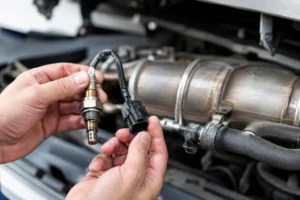
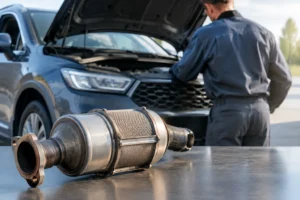
A DPF problem rarely begins with a complete breakdown. More often, it starts with a warning light that goes away after a longer run, a van that feels slightly flat under load, or fuel consumption creeping up for no obvious reason. The best signs of blocked DPF are usually a pattern of symptoms rather than one fault alone – and acting early can make the difference between a controlled regeneration and an expensive repair.
The diesel particulate filter, or DPF, sits in the exhaust system and traps soot produced by the engine. It is designed to clean itself through regeneration, where exhaust temperatures rise enough to burn the soot away. That process works well when the vehicle gets the right driving conditions and the engine has no underlying faults. Short trips, failed sensors, EGR issues and interrupted regenerations can all prevent it from doing its job.
Best signs of blocked DPF to look out for
A DPF warning light that stays on
The most obvious symptom is the DPF warning light. On many cars and vans, this first appears when the filter has reached a soot level that needs a proper regeneration. Some vehicles will also display a message telling you to keep driving or that the particulate filter is full.
A warning light does not automatically mean the DPF needs replacing. If the vehicle is otherwise running correctly and the soot loading is still within range, a suitable uninterrupted drive may allow an active regeneration to complete. However, repeatedly clearing the warning light or hoping it disappears is not a repair. If the conditions that caused the blockage remain, it will return.
Reduced power or limp mode
A badly restricted DPF creates excessive exhaust back pressure. The engine control unit may respond by limiting power to protect the engine, turbocharger and exhaust system. You may notice poor acceleration, a lack of pulling power on hills, or a van that struggles when loaded.
This is often called limp mode. It can feel dramatic, but it is the vehicle trying to prevent further damage. Switching the ignition off and back on may temporarily restore power on some models, yet the stored fault and underlying cause will still be present.
Cooling fan running after you switch off
If the cooling fan continues running after the engine has been turned off, the vehicle may have been attempting an active DPF regeneration. During this process, the engine management system increases exhaust temperature, often using additional fuel injection.
One fan run-on event is not proof of a blocked filter. It becomes significant when it happens regularly, particularly alongside a warning light, poor fuel economy or a hot smell from beneath the vehicle. Frequent attempted regenerations suggest the car is not completing the process successfully.
Higher fuel consumption and an unusual hot smell
A diesel that is regenerating more often will normally use more fuel. The change can be noticeable for commuters who know their usual mileage, and especially for tradespeople covering the same routes each week.
You may also smell hot exhaust components, or notice a sharp, hot odour after parking. This can be normal during a successful regeneration, but it should not happen on every short journey. Do not ignore heat warnings, smoke, or a burning smell that is severe or persistent.
Stop-start no longer works
On many modern diesel vehicles, the stop-start system is disabled when the ECU believes a regeneration is needed or exhaust temperatures are too high. Stop-start has plenty of other conditions that can prevent it working, including battery state and outside temperature, so it is not a diagnosis by itself.
Used alongside other symptoms, though, it is a useful clue. A car with disabled stop-start, a raised idle speed, running cooling fans and a DPF message may be trying to regenerate.
Engine management light and fault codes
A DPF restriction can trigger the engine management light, sometimes with no dedicated DPF warning at all. Common fault codes relate to particulate filter efficiency, pressure sensor readings, exhaust temperature sensors or soot loading. Codes such as P2002, P2463 and P2458 are frequently associated with DPF faults, but the exact meaning depends on the vehicle and the data recorded when the fault occurred.
The code is a starting point, not a parts list. For example, a DPF pressure sensor fault can make the ECU calculate the filter loading incorrectly. Replacing or cleaning the DPF without checking the sensor, its pipes and live readings can waste money and leave the real problem unresolved.
Why DPFs become blocked
The most common cause is repeated short-distance driving. The engine and exhaust do not stay hot enough for long enough to complete regeneration, so soot continues to build up. This is common on school-run cars, city commuters and working vans that spend the day stopping and starting.
But driving style is not the only answer. A DPF that keeps blocking after proper motorway runs may have another fault preventing regeneration. Failed exhaust gas temperature sensors, differential pressure sensors, EGR faults, boost leaks, injector problems and thermostat issues can all affect how the system operates. On some diesel models, an AdBlue or SCR fault may be separate from the DPF issue, although both may illuminate warning lights and need proper diagnosis.
There is also a difference between soot and ash. Soot can usually be removed through regeneration if the filter and engine are otherwise healthy. Ash is a non-combustible residue that slowly accumulates over the life of the filter. A high ash load cannot be burned off by driving harder. Depending on the filter’s condition, professional cleaning or replacement may be required.
Should you take it for a motorway run?
A sustained drive can help if the DPF warning has only just appeared, the vehicle has no engine management faults, and it is still driving normally. The key is a continuous run once the engine is fully warm, rather than a few bursts of fast driving between junctions. Your handbook may give manufacturer-specific instructions.
Do not force the issue if there is a flashing warning light, serious loss of power, excessive smoke, overheating, a high engine oil level or a message saying the filter is overloaded. Continuing to drive a vehicle that cannot regenerate can increase exhaust temperatures and may lead to more costly damage.
It is also worth checking the oil level. Repeated failed regenerations can allow fuel to dilute the engine oil on certain engines. If the oil level is above the maximum mark, do not assume it is harmless – the vehicle needs assessment before further use.
What a proper DPF diagnosis should involve
A proper diagnostic process goes beyond reading codes and clearing the dashboard light. It should check live DPF differential pressure readings, calculated soot and ash loading, exhaust temperature sensor operation, regeneration history and any faults that would block a regeneration.
The technician should also consider how the vehicle is used. A motorway-driven car with a blocked DPF points more strongly towards an underlying engine or sensor fault than a vehicle used only for short local trips. This context matters when deciding whether a forced regeneration is appropriate, whether the filter needs cleaning, or whether another fault must be repaired first.
At Tech Tuning Northwest, DPF faults are diagnosed from the data and the vehicle’s behaviour, not from a guess based on one warning light. Mobile diagnostics can be particularly useful when a vehicle is in reduced-power mode or a working van cannot be easily left at a garage.
A blocked DPF is usually giving you a warning before it becomes a larger job. Treat a new light or change in performance as useful information, get the cause checked properly, and you stand a much better chance of keeping the repair straightforward.