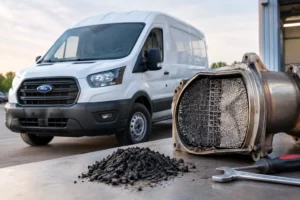
A DPF warning light does not automatically mean the filter needs replacing. The best DPF cleaning methods depend on how blocked it is, what is blocking it, and why the vehicle stopped regenerating in the first place. Get that wrong and it is easy to spend money on a cleaning attempt that cannot work – or replace a DPF when the real fault is a sensor, thermostat, injector, EGR valve or AdBlue-related issue.
A diesel particulate filter collects soot from the exhaust. During normal driving, the engine management system periodically raises exhaust temperatures to burn that soot away. This is called regeneration. The process works well when the car reaches temperature and is driven for long enough, but short journeys, interrupted regenerations and underlying engine faults can turn a manageable soot build-up into a costly blockage.
What is actually inside a blocked DPF?
There are two different deposits, and they matter. Soot is carbon and can usually be burned off during a successful regeneration. Ash is the non-combustible residue left behind from oil additives and normal engine wear. Ash does not burn away, no matter how hard or how long the car is driven.
This is why a long motorway run can sometimes clear a warning light, yet make no difference to another vehicle with similar symptoms. A DPF loaded mainly with soot may recover if the conditions are right. A filter full of ash needs physical cleaning off the vehicle, or replacement if it is damaged.
Diagnostic readings are more useful than guesswork. A proper scan should check calculated soot load, ash load where supported, differential pressure, exhaust temperature sensor readings, regeneration history and any stored fault codes. On many BMW, Volkswagen Group, Mercedes-Benz, Ford and Peugeot/Citroen diesels, one small fault can prevent regeneration without making the root cause obvious to the driver.
Best DPF cleaning methods, ranked by the problem
A proper regeneration drive
For a lightly soot-loaded DPF with no active faults, a sustained drive can be the simplest solution. The engine needs to be fully warm, with enough fuel in the tank, and driven steadily under load for long enough to allow an active regeneration to complete. A dual carriageway or motorway journey is usually more suitable than stop-start town driving.
This is not simply a case of driving flat out. High engine speed alone does not guarantee a regeneration, and repeatedly forcing a struggling vehicle down the road can create more problems. If the DPF light is flashing, the engine is in reduced power, there is an engine management light, or the oil level has risen, stop treating it as a clearing run and have it checked.
A regeneration drive will not remove ash, repair a failed pressure sensor or fix an EGR fault. It is best viewed as a sensible first step only when diagnostics show the DPF is still within a safe soot-loading range.
Diagnostic-led forced regeneration
A forced regeneration uses diagnostic equipment to command a regeneration while the vehicle is stationary or driven in controlled conditions. It can raise exhaust temperatures substantially, which is why it must only be carried out after checks have confirmed it is safe.
Before attempting one, a specialist should look for faults that caused the blockage. Common examples include a stuck-open EGR valve, faulty exhaust temperature sensor, split boost hose, inaccurate differential pressure sensor, failed glow plugs on some engines, or a thermostat that leaves the engine running too cool. If the cause remains, the DPF may block again within days.
Forced regeneration can be very effective for soot. It is not a cure for a severely restricted filter, heavy ash accumulation or a cracked DPF core. Attempting it on an excessively loaded DPF can overheat and damage the filter or surrounding components.
In-situ chemical DPF cleaning
In-situ cleaning involves applying a purpose-made cleaning solution through an appropriate access point, then running a controlled regeneration where suitable. The aim is to loosen soot and some deposits so they can be burned off or expelled through the exhaust.
This can be a good middle ground where the DPF is restricted but not physically damaged, particularly where a forced regeneration alone is unlikely to succeed. Results depend heavily on the chemical used, the application method and, above all, whether the underlying fault has been corrected.
Be cautious with services that promise every blocked DPF can be cleaned in minutes without diagnostic checks. A cleaner cannot fix a pressure sensor reporting nonsense, a leaking injector creating excessive soot or an engine that never reaches operating temperature. It can also be poor value on a DPF that is predominantly full of ash.
Off-car professional DPF cleaning
For a filter with significant ash loading, off-car cleaning is generally the most thorough option short of replacement. The DPF is removed, inspected and cleaned using specialist equipment. Depending on the process, this may involve controlled air, fluid flushing and flow testing before and after cleaning.
The advantage is that accumulated ash can be physically removed rather than simply heated. It also gives an opportunity to inspect the substrate for cracks, melting or contamination. A cleaned filter should show a meaningful improvement in flow or pressure readings – not just look clean on the outside.
The trade-off is labour. Access on some vehicles is straightforward; on others, removal can take time because of seized fixings, tight packaging and heat-damaged exhaust hardware. It is still often considerably cheaper than fitting a new genuine DPF, provided the core is sound and the original fault is resolved.
DPF replacement
Replacement is the right answer when the filter is cracked, melted, contaminated beyond recovery or too damaged to clean reliably. It is also sometimes the practical choice when removal and cleaning costs approach the price of a quality replacement unit.
Quality matters. Cheap pattern DPFs can cause problems with poor fitment, incorrect catalyst loading or short service life. Equally, replacing the DPF without diagnosing why it blocked is a false economy. A new filter fitted to an engine with a failed thermostat, injector issue or sensor fault can soon develop the same restriction.
Methods that are often oversold
Fuel-borne DPF additives may help reduce the temperature at which soot burns, and they can be useful as preventative support on a healthy system. They are not a reliable answer to a warning light, a seriously blocked DPF or an ash-filled filter. Pouring a bottle into the tank and hoping for the best is rarely a diagnosis.
Pressure washing, harsh unapproved chemicals and drilling or cutting the DPF are not proper repairs. Physical removal or alteration of emissions equipment is illegal for road use in the UK and can lead to MOT failure, insurance problems and further fault codes. More importantly, it leaves the original engine issue unsolved.
Symptoms that mean diagnosis should come first
A DPF light alongside reduced power, frequent cooling-fan operation, poor fuel economy, a strong hot smell after switching off or repeated failed regenerations deserves proper investigation. An oil level that has risen can be particularly urgent. Diesel fuel may have diluted the engine oil during unsuccessful regeneration attempts, reducing its protective qualities.
The same applies if the warning light returns shortly after a regeneration or cleaning. That pattern normally points to a reason the vehicle is producing too much soot or cannot meet the conditions needed to regenerate. Reading fault codes is only the start. Live data tells the fuller story.
For drivers who rely on a diesel car or van for work, the most cost-effective route is normally diagnosis first, then the least invasive cleaning method that genuinely fits the readings. Tech Tuning Northwest provides mobile diesel diagnostics across Greater Manchester, helping owners establish whether a regeneration, repair, cleaning process or replacement is actually justified before approving unnecessary work.
A DPF is not a service item to ignore until the warning light appears. If your journeys are mostly short, give the vehicle regular runs that allow it to reach full temperature, use the correct low-SAPS oil, and act early when regeneration-related symptoms begin. A filter that is soot-loaded today is often recoverable; one repeatedly driven while restricted may not be.