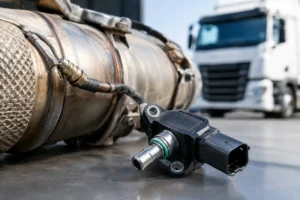
A P204F fault code can turn a routine journey into a serious problem quickly, especially when the dashboard also shows an AdBlue warning or a mileage countdown to no engine restart. It does not automatically mean the whole AdBlue system needs replacing. It means the engine control unit has decided the SCR emissions system is not performing as it should, and the real cause needs identifying before parts are fitted.
On many diesel cars and vans, P204F is described as Reductant System Performance, Bank 1. “Reductant” is the technical term used for AdBlue. Bank 1 simply refers to the relevant exhaust side or system monitored by the vehicle. On most four-cylinder diesels, it is not something the driver needs to worry about. The key point is that the vehicle cannot confirm the AdBlue and SCR system is reducing NOx emissions properly.
What the P204F fault code means
Modern Euro 6 diesel vehicles use selective catalytic reduction, usually shortened to SCR, to lower harmful nitrogen oxide emissions. The system injects a carefully measured amount of AdBlue into the exhaust. Heat converts it into ammonia, which reacts inside the SCR catalyst to reduce NOx emissions.
For this process to work, the vehicle needs several components to agree with each other: the AdBlue tank and quality sensor, pump, heater, injector, pipes, NOx sensors, exhaust temperature sensors, wiring and the SCR catalyst itself. If the control unit sees readings or pressure values outside its expected range, it may log P204F.
That is why this is a performance code rather than a simple “replace this part” code. A scan tool may show P204F alongside more specific faults that point towards low pressure, a heater problem, a dosing injector fault or an implausible NOx sensor reading. Those accompanying codes and live data are often where the diagnosis begins.
Symptoms drivers commonly notice
The first sign is often an engine management light, AdBlue warning, or a message such as “emissions fault” or “AdBlue system fault”. Depending on the make and model, the warning may be followed by a restart countdown. Once that reaches zero, the engine may crank but will not start until the fault is correctly repaired and the system accepts the repair.
Some vehicles continue to drive normally at first. Others can enter reduced-power mode, particularly if there are related emissions faults present. You may also notice increased AdBlue use, no visible AdBlue consumption at all, or a warning that remains after topping up the tank.
A P204F code is common across a range of European diesels, including Peugeot, Citroen, Vauxhall, Volkswagen Group, Mercedes-Benz, BMW, Ford and Renault-based vans. The wording on the dash and the exact failure pattern vary, but the diagnostic principle is the same: do not assume that adding more AdBlue will cure an electronic or mechanical system fault.
Common causes of a P204F code
AdBlue tank, pump or pressure faults
The AdBlue tank module is a frequent cause. Many systems contain the pump, pressure sensor, level sensor and heating elements within the tank assembly. If the pump cannot build or maintain the correct pressure, the ECU cannot dose AdBlue accurately and may log P204F.
Cold weather can expose a weak system because AdBlue freezes at around -11°C. The system is designed with heaters to deal with this, but a failed tank heater, damaged wiring or a failed internal sensor can prevent normal operation. A fault may appear after freezing conditions, yet the underlying issue may be an ageing tank module rather than the weather itself.
Crystallisation is another concern. AdBlue is not fuel additive and should never be mixed with anything else. Contamination, leaks around connectors, or repeated short journeys can leave white crystal deposits around the injector or pipework. These deposits can restrict flow and affect pressure readings.
Blocked or leaking AdBlue injector
The dosing injector sits in the exhaust and sprays a fine quantity of AdBlue upstream of the SCR catalyst. If its nozzle becomes blocked with crystals, leaks, or cannot produce the correct spray pattern, the system may fail its performance checks.
An injector problem can be relatively straightforward to resolve if caught early. However, allowing heavy crystallisation to build up can affect the injector housing, pipework and exhaust section. The sensible repair depends on what testing finds, not just what is visible from underneath the vehicle.
Failed NOx sensor or inaccurate sensor readings
NOx sensors monitor exhaust gases before and after the SCR catalyst. The ECU compares those readings to judge whether the system is working. A sensor that is slow, contaminated, electrically faulty or reporting implausible values can make a healthy AdBlue system appear ineffective.
This is one reason why replacing the AdBlue tank on a guess can become expensive. A NOx sensor can cause P204F, but so can a genuine dosing fault that makes the NOx sensor report poor conversion. Live data, sensor response and stored fault codes need to be assessed together.
Wiring, connectors and communication faults
The AdBlue tank sits under the vehicle on many cars and vans, where wiring and connectors are exposed to water, road salt and impact damage. Corrosion at a connector, chafed wiring or a poor earth can create intermittent faults that are easy to miss during a quick visual check.
Some systems also suffer from control module communication faults. The dashboard warning may look identical to a pump or injector issue, but the fault may be caused by an electrical supply problem. Proper voltage-drop and wiring checks matter, particularly where parts have already been replaced without success.
SCR catalyst efficiency problems
Less commonly, P204F can be linked to an SCR catalyst that is no longer converting NOx effectively. This can happen after prolonged incorrect dosing, exhaust contamination or other unresolved engine faults. It is not the first component we would condemn, because catalyst replacement is costly and poor sensor data can mimic catalyst failure.
Can you keep driving with P204F?
If there is no countdown and the vehicle drives normally, you may be able to use it for a short period. But it is not a fault to ignore. The longer it is left, the greater the chance of a no-start condition, further crystallisation or an unsuccessful MOT emissions check.
If a restart countdown has begun, arrange diagnosis promptly. Do not wait until the remaining distance is nearly zero, and do not repeatedly clear the code with a basic scanner. Clearing a warning does not repair the fault or reset the system’s underlying test results. In some cases, repeated clearing can make the history harder to interpret.
Do not overfill the AdBlue tank or use unsealed, old or poor-quality fluid in the hope of curing the warning. If the level was genuinely low, topping up with correct AdBlue may help. If P204F is stored with a system fault, adding fluid alone is unlikely to be the answer.
Diagnosing P204F properly
A worthwhile diagnosis starts with a full vehicle scan, not just reading one generic code. The technician should check manufacturer-specific codes, freeze-frame information and the conditions under which the fault set. From there, live data can show AdBlue pressure, tank level and temperature, requested versus actual dosing, NOx sensor readings and exhaust temperatures.
The next step depends on the vehicle and related faults. It may involve testing the pump’s ability to prime and hold pressure, running an injector test, inspecting for crystallisation, checking power and earth supplies, or checking sensor readings against expected values. In some cases, an SCR efficiency test or guided diagnostic routine is needed after repairs.
There is a trade-off between speed and certainty. A common-failure part may be a strong suspect, but fitting it without testing can leave you paying for a part that was never faulty. This is particularly frustrating on vans and working vehicles, where downtime costs more than the diagnosis itself.
Repair options after a P204F fault code
The correct repair may be as modest as cleaning or replacing a dosing injector, repairing wiring or fitting a failed sensor. Where a tank module has failed internally, replacement may be necessary. Some vehicles then require adaptations, priming procedures, fault resets or a successful SCR test before the countdown is removed.
Be cautious of blanket advice that every P204F means a new AdBlue tank, or that every warning can be solved by software alone. Both claims overlook how these systems are designed. The repair needs to match the confirmed fault and leave the vehicle operating correctly.
For drivers in Greater Manchester dealing with an AdBlue warning, emissions fault or restart countdown, Tech Tuning Northwest can carry out specialist diesel diagnostics at home or work where suitable. The useful next move is to get the code read properly before the vehicle reaches a point where it will not restart.