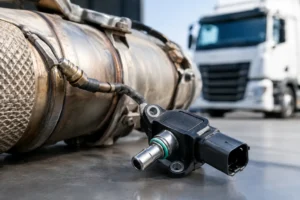
A Ford Transit that earns its keep cannot afford repeated warning lights, limp mode or time off the road. If you are searching for a Ford Transit DPF ash case, you are usually trying to establish whether the diesel particulate filter is genuinely at the end of its life, or whether somebody has jumped too quickly to an expensive replacement quote.
The short answer is that ash inside a DPF is real, permanent and cannot be removed by a normal regeneration. But an ash-related message, fault code or live-data reading does not automatically prove that the filter itself needs replacing. On a Transit, the pressure sensor, its pipes, engine condition and the ECU’s calculated values all need checking before a repair decision is made.
What does a Ford Transit DPF ash case mean?
A diesel particulate filter traps soot from the exhaust. Soot is the black carbon produced during combustion. When conditions are right, the ECU raises exhaust temperatures and burns that soot away during an active regeneration.
Ash is different. It is the non-combustible residue left behind by normal engine oil additives, fuel additives and tiny amounts of oil burned by the engine over time. It settles in the DPF channels and gradually reduces the available space for soot. No motorway run, forced regeneration or dashboard reset can burn it away.
The wording varies with the diagnostic equipment being used. A garage may refer to an ash load, ash accumulation, an ash counter or an ash case. The key point is that the vehicle’s ECU either believes the DPF has reached its calculated ash limit, or the measured exhaust pressure suggests that it is becoming restricted.
On high-mileage Ford Transits, especially working vans doing stop-start local jobs, this can eventually be a genuine end-of-life issue for the original DPF. However, calculated ash values are not always the full story. The ECU estimates ash over time, and incorrect sensor readings or previous unsuccessful repairs can make the situation look worse than it is.
Ash loading versus soot loading
Knowing the difference prevents a lot of wasted money. A soot-loaded DPF may be recoverable with a successful regeneration once the underlying cause has been corrected. A filter carrying too much ash needs to be professionally cleaned off the vehicle or replaced, depending on its condition.
A Transit that mostly covers short journeys may struggle to complete regenerations. Soot then rises faster than the ECU can clear it. The driver may see a DPF warning, reduced engine power, increased fuel consumption or a cooling fan running after the ignition has been switched off.
If ignored, excessive soot can become a serious restriction. The ECU may eventually refuse to start another regeneration because exhaust temperatures and differential pressure are no longer within safe limits. Trying to force a regeneration on a badly blocked filter can overheat the DPF and create further damage.
Ash loading tends to be slower and less dramatic, but it reduces the DPF’s capacity permanently. That means a van can start needing regenerations more often, even after the engine itself is running correctly. A professional clean can remove ash from a suitable filter, restoring its flow and usable capacity. It cannot repair a melted, cracked or contaminated DPF core.
Symptoms Transit owners often notice
The first sign may be a yellow engine management light or DPF warning light. In other cases, the van simply feels flat when loaded, struggles on hills or enters reduced-power mode. Some drivers notice that fuel economy has worsened and regenerations seem more frequent.
Common fault codes associated with DPF restriction include P2463 for excessive soot accumulation, P242F for DPF ash accumulation, P2002 for particulate filter efficiency, and P2452 or related codes for the differential pressure sensor circuit. A code alone is not a diagnosis. For example, P2463 can appear because of a split pressure hose or a faulty sensor, not only because the DPF is blocked.
On later Euro 6 Transits, an AdBlue or NOx sensor problem may also be present. These are separate emissions systems, but several warnings at once can make it difficult to tell which fault is causing the reduced performance. Reading every stored and pending code, rather than clearing the lot and hoping for the best, matters.
Why the ash value may be misleading
The ECU does not physically weigh the ash in the filter. It calculates an estimated ash quantity using mileage, fuel use, regeneration history and other operating data. This calculation is useful, but it has limitations.
A DPF may have been replaced in the past without the relevant adaptation being reset. Equally, somebody may have reset an ash counter without cleaning or replacing the filter. Either situation leaves the ECU’s figure out of step with reality.
The differential pressure sensor is equally important. It compares pressure before and after the DPF. If the sensor is inaccurate, its electrical connector is corroded or the small pressure pipes are blocked, cracked or full of moisture, live data can falsely suggest a restricted filter. That is why a proper diagnosis checks pressure readings at idle and under load, rather than relying on a single number on a code reader.
Excessive oil consumption also needs attention. Worn turbo seals, crankcase-breather issues or internal engine wear can send oil into the exhaust, increasing ash and contaminating the filter. Using the correct low-SAPS engine oil is another practical point. The wrong oil may save a few pounds at a service but can shorten DPF life significantly.
How a Ford Transit DPF ash fault should be diagnosed
A sound diagnosis starts by scanning the van properly and checking all relevant engine, DPF, sensor and AdBlue-related faults. Freeze-frame data can show the conditions present when a code was stored, which is often more useful than the code description alone.
The next step is to compare calculated soot and ash figures with the actual differential pressure readings. Sensor pipes should be inspected, and the sensor itself tested where readings do not make sense. Exhaust temperature sensors must also be working, because the ECU uses them to manage regeneration safely.
The technician should then establish why the soot built up. Frequent short runs are common, but they are not the only cause. An EGR fault, boost leak, injector issue, failing thermostat, glow plug fault or interrupted regeneration can all contribute. Fixing only the blocked DPF while leaving the cause in place is how the same van returns a few weeks later with the same light on.
A road test with live data is often the deciding factor. It shows whether temperatures rise as expected, whether pressure increases excessively under load and whether a regeneration is being requested or completed. This is far more reliable than guessing from mileage alone.
Cleaning, replacement or regeneration?
A standard forced regeneration is appropriate only when soot loading is within safe limits and there is no fault preventing regeneration. It is not an ash-removal service. If the filter is ash-loaded but structurally sound, professional off-vehicle DPF cleaning is normally the sensible middle ground between repeated forced regenerations and fitting a new unit.
During proper cleaning, the DPF is removed and treated to release ash and deposits from the filter channels, then flow-tested. The result should be assessed honestly. A badly damaged core, persistent oil contamination or a filter that will not flow correctly after cleaning may require replacement instead.
Be wary of anyone promising that a bottle poured into the fuel tank will remove heavy ash deposits. Additives may support combustion in certain circumstances, but they do not reverse a genuinely ash-filled DPF. Likewise, deleting DPF functions in the ECU is not a legitimate repair and can create MOT, insurance and legal problems.
Getting a working Transit back on the road
For van owners, the best repair is the one that solves the cause and prevents a repeat visit. Tech Tuning Northwest diagnoses Transit DPF faults using live data and targeted testing, including mobile appointments across Greater Manchester where suitable. That approach helps separate a genuinely worn-out filter from a sensor fault, a soot issue or an engine condition that has been missed elsewhere.
If your Transit is showing a DPF or engine warning light, avoid repeated short trips and do not keep attempting regenerations blindly. Get the fault assessed while the van is still driveable. A clear diagnosis early on is usually cheaper than waiting for limp mode, a failed regeneration or a DPF that is damaged beyond cleaning.