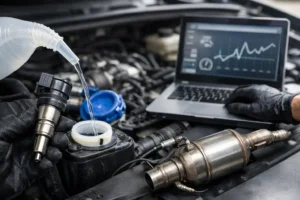
An AdBlue warning is easy to dismiss when the vehicle is still driving normally. The problem is that many systems will eventually display a mileage countdown and, once it reaches zero, prevent the engine from restarting. Understanding the five causes of AdBlue faults helps separate a simple top-up issue from a fault that needs proper diagnosis before money is spent on parts.
AdBlue is not a fuel additive. It is a measured mix of high-purity urea and deionised water, stored in a separate tank. The vehicle injects it into the exhaust, where the SCR system uses it to reduce nitrogen oxide emissions. For that process to work, the tank, pump, heater, injector, sensors, wiring and engine control software all need to agree that the correct amount of fluid is being delivered.
That is why an AdBlue message can be misleading. A full tank does not necessarily clear a warning, and topping up repeatedly can make no difference if the real fault is elsewhere.
The five causes of AdBlue faults
1. Low, poor-quality or contaminated AdBlue
The obvious cause is a genuinely low AdBlue level. Many cars and vans give plenty of warning before the tank is empty, but the final messages can be urgent: “No engine start possible in 650 miles” is common on several European diesels.
Use AdBlue that meets ISO 22241 and comes from a sealed, reputable container or a properly maintained pump. The fluid has a shelf life, particularly if it has been stored in a hot shed, direct sunlight or a partly opened bottle. Dirt, diesel, screenwash or ordinary water getting into the tank can contaminate the system and cause crystallisation or damage to components.
Low-quality fluid is not the most common explanation for every warning light, but it is the first thing worth ruling out. If the warning appeared shortly after filling up, or if the filler neck has been contaminated, that timing matters. Simply adding more fluid to a contaminated tank is not a repair. Depending on the extent of contamination, the tank and supply system may need to be drained, cleaned and assessed.
2. AdBlue crystallisation around the injector or pipework
AdBlue naturally forms crystals when it dries. A small amount of white residue around the filler area is not always serious, but heavy crystallisation around the injector, delivery pipe or tank connections can restrict flow and create a pressure fault.
This is particularly common where a vehicle makes frequent short trips, sits unused for long periods or has a small leak that allows fluid to dry on the outside of a component. The injector sits in a very hot part of the exhaust system, so deposits can build up at its tip. Once restricted, it may under-dose the exhaust or spray poorly, causing emissions-related fault codes and an engine management light.
It is tempting to scrape deposits away and hope for the best. External cleaning can help inspection, but it does not prove that the injector is flowing correctly or that a blocked line has been cured. A proper diagnosis checks commanded dosing, system pressure and, where appropriate, the injector and pipework condition.
3. A failed AdBlue pump, heater or tank module
On many vehicles, the pump, level sensor, temperature sensor and heating elements are built into the AdBlue tank assembly. This is one reason quotes can become expensive: manufacturers often supply a complete tank module rather than every internal component separately.
The pump has to build and hold pressure before the system can inject fluid. If it cannot, the ECU may store faults for low pressure, pressure build-up time or dosing performance. In colder weather, heater faults can also become more noticeable. AdBlue freezes at around -11°C, and the system relies on heaters to thaw it so the vehicle can dose correctly after start-up.
Symptoms vary by make. You may see an amber engine warning light, an AdBlue system warning, a countdown message, or a fault that returns shortly after being cleared. Some Volkswagen Group, Mercedes, Peugeot, Citroen, Ford, BMW and Jaguar Land Rover diesels have different system designs, but the basic checks are similar: is the tank reporting a believable level and temperature, does the pump run, and can it produce the required pressure?
A fault code alone cannot always condemn the tank. Wiring damage, corroded connectors, blown fuses and low battery voltage can produce similar symptoms. Replacing a costly tank without testing its power supply and live data first is an avoidable mistake.
4. Faulty NOx sensors or exhaust temperature readings
The SCR system does not just inject AdBlue and assume the job is done. NOx sensors measure nitrogen oxide levels in the exhaust, usually before and after the SCR catalyst. The ECU uses their readings to judge whether the system is reducing emissions as expected.
If a NOx sensor fails, responds too slowly or sends implausible readings, the ECU may report an AdBlue or SCR efficiency fault even when the tank, pump and injector are working. This is a common source of confusion because drivers often focus on the AdBlue warning wording, while the real issue is an exhaust sensor.
NOx sensors operate in extreme heat and have their own control electronics, making them a regular failure point on higher-mileage diesels. A damaged sensor wiring loom, water ingress at a connector or a previous exhaust repair can also cause the same sort of code.
The right approach is to read manufacturer-level fault information and look at live data. A specialist should compare upstream and downstream NOx readings, check whether the sensors heat up and respond, and consider other faults that can affect emissions calculations. Fitting a new sensor based only on a generic code reader can be a gamble, especially when several related faults are stored.
5. SCR catalyst, software or underlying engine faults
Sometimes the AdBlue system is doing what it has been told to do, but the exhaust after-treatment system is not achieving the expected result. A degraded SCR catalyst can cause poor NOx conversion. Exhaust leaks before or around the sensors can draw in air and distort readings. A DPF issue, EGR fault or combustion problem can also alter exhaust temperatures and emissions enough to confuse the wider system.
Software is another consideration. Some vehicles have manufacturer calibration updates that change SCR monitoring thresholds or improve the way a known issue is managed. That does not mean every warning needs a software update, nor should software be used to hide a mechanical fault. It does mean a diagnostic process should check the vehicle’s software status where it is relevant.
This is the point where a quick reset is least useful. Clearing codes may remove the dashboard warning temporarily, but the ECU will run its self-tests again. If the underlying efficiency problem remains, the warning and restart countdown usually return. More importantly, repeated resets can waste time while the vehicle moves closer to a non-start condition.
What to do when an AdBlue warning appears
First, read the exact message and take a photo of it, including any mileage countdown. If the level is genuinely low, add the correct AdBlue carefully without overfilling. Avoid using funnels or containers that have held other fluids. After a top-up, some vehicles need an ignition cycle and a short drive before the level display updates.
If the warning remains, do not assume the tank needs replacing. Get the fault codes read with equipment capable of accessing the engine and SCR control data, not just a basic code scanner. The useful checks include stored and pending codes, AdBlue tank level and temperature, pump pressure, heater operation, injector command, NOx sensor values, exhaust temperatures and battery voltage.
Do not ignore a restart countdown. A vehicle that starts and drives today may be unable to restart after being parked at work, at home or on a job. If the countdown is already low, arranging diagnosis before switching the engine off can prevent unnecessary recovery costs.
Why accurate diagnosis saves money
AdBlue faults often produce overlapping symptoms. A pressure code could be a pump, blocked line, frozen fluid, wiring issue or control problem. An SCR efficiency code could point to the catalyst, injector, NOx sensors, exhaust leak or an engine fault affecting emissions. There is no honest one-part answer that suits every vehicle.
For drivers across Greater Manchester who rely on a diesel car or van, Tech Tuning Northwest can carry out targeted diagnostics at home or work, using live data and fault-code interpretation to identify the cause before recommending repairs. That is particularly useful when a garage has suggested an expensive tank or sensor replacement without a clear test result behind it.
Treat an AdBlue warning as an early chance to diagnose the system, rather than something to clear and revisit later. A clear fault report and a measured repair plan are usually far cheaper than reaching the point where the vehicle will not restart.