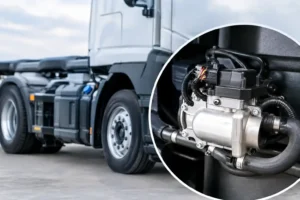
When an AdBlue warning appears, many drivers are quoted for an entire tank or told the injector is blocked without a proper test. The AdBlue injector versus pump question matters because these are different components with different jobs, symptoms and repair costs. Replacing the wrong one can be an expensive guess – and it may do nothing to stop a no-start countdown.
What the AdBlue pump and injector actually do
Your vehicle’s Selective Catalytic Reduction (SCR) system reduces harmful nitrogen oxide emissions in the exhaust. It does this by storing AdBlue fluid in a dedicated tank, moving it through a supply line, then injecting a measured amount into the exhaust before the SCR catalytic converter.
The AdBlue pump is responsible for drawing fluid from the tank and delivering it under controlled pressure. On many cars and vans, the pump is part of the tank assembly alongside the heater, level sensor and pressure sensor. It is not simply a basic washer-bottle pump. It must work reliably in cold weather, cope with a corrosive fluid and communicate with the engine ECU.
The AdBlue injector, also called a dosing valve or doser, sits in the exhaust pipe. Its job is to spray a fine, calculated dose of AdBlue into the hot exhaust stream. The ECU changes the dose according to engine load, exhaust temperature and feedback from the NOx sensors.
Put simply: the pump gets AdBlue to the injector; the injector puts it into the exhaust. Neither can do its job properly without the other.
AdBlue injector versus pump: how the faults differ
A failed pump usually prevents the system from building or maintaining the required pressure. The ECU may detect a pressure that is too low, too high or slow to respond. Depending on the vehicle, this can bring up an engine management light, an AdBlue system warning or a message telling you that the engine will not restart after a certain mileage.
Common pump-related signs include repeated pressure-related fault codes, a warning that returns shortly after being cleared, or a vehicle that cannot complete its AdBlue priming routine. In colder weather, a fault may also involve the tank heater or temperature sensor rather than the pump motor itself.
An injector fault is often more visible around the exhaust. AdBlue can crystallise when it dries, leaving a hard white deposit around the injector tip, the mounting point or the pipework. This can restrict the spray pattern, cause leaks or prevent the injector from opening correctly. A blocked injector can lead to poor NOx conversion even when the pump is supplying fluid correctly.
The two faults can overlap. A weak pump may not supply enough pressure for accurate dosing, while a partially blocked injector can make the system appear to have a pressure problem. That is why a fault code alone is not enough to condemn either part.
Why AdBlue components fail
AdBlue is a mixture of purified water and urea. It is not fuel, and it must remain clean. Small amounts of contamination, old fluid, damaged wiring or an air leak in the supply side can upset the system. Crystallisation is especially common around injector connections because the exhaust system is hot and any escaped fluid dries quickly.
On vehicles such as Peugeot, Citroen, Vauxhall, Volkswagen, Audi, BMW, Mercedes-Benz, Ford and Land Rover diesels, the layout and common weak points vary. Some vehicles are more prone to tank module and pump faults, while others regularly suffer from injector deposits, wiring issues or failed NOx sensors. The make badge does not diagnose the fault.
Short journeys can contribute where the exhaust does not consistently reach the temperatures needed for the SCR system to operate as intended. However, it would be wrong to blame every AdBlue fault on driving style. A failed sensor, damaged harness, poor-quality previous repair or internal tank fault can affect a motorway-driven vehicle just as easily.
Symptoms that point towards the injector
White crystals around the exhaust-mounted doser are a strong clue, particularly if there is a noticeable AdBlue smell or a visible leak. A technician may find that the injector is mechanically stuck, electrically open circuit or unable to deliver the correct spray pattern.
You may also see efficiency or NOx-related codes because the exhaust gases are not receiving the intended dose of fluid. The engine can still drive normally at first, which catches many owners out. Once the ECU decides the SCR system cannot meet emissions requirements, it may begin a restart countdown.
A blocked injector is not always beyond saving. In some cases, careful removal and assessment can establish whether cleaning is sensible. If the electrical side has failed, the nozzle is badly corroded or the spray performance remains poor, replacement is usually the sensible route.
Symptoms that point towards the pump or tank module
Pump problems more often show as a system-wide fault: no pressure, implausible pressure readings, inability to prime, or a warning that returns immediately after a reset. You may hear the pump run briefly when the vehicle performs a self-check, although the absence of noise is not proof that it has failed.
A pump module can also be affected by its supporting parts. Tank heaters, level sensors, quality sensors and internal wiring can all be packaged in the same assembly. This is why a garage may quote for a complete tank unit even where the customer has been told it is “just the pump”.
Before accepting that quote, the supply voltage, earth, wiring integrity, live pressure data and commanded pump operation should be checked. A corroded connector or damaged wiring loom can imitate a failed pump and cost far less to rectify.
Why fault codes need interpreting, not just clearing
Fault codes are useful starting points, not a list of parts to fit. A code may identify low pressure, dosing control, NOx conversion or communication with the AdBlue control unit. It does not always tell you whether the cause is the pump, injector, pipework, sensor or wiring.
Proper diagnosis normally includes reading manufacturer-level fault information, checking live data, inspecting for crystals and leaks, and carrying out relevant actuator or pressure tests. The vehicle may also need an SCR reset, priming procedure or adaptation after a genuine repair. Simply clearing the dashboard warning without fixing the cause usually gives the problem time to return – often with fewer restart miles remaining.
Be wary of anyone who promises a diagnosis solely from a photograph of the warning message. The same dashboard wording can be triggered by several completely different faults.
Can you keep driving with an AdBlue fault?
If the vehicle is still running, it may remain usable for a limited period, but do not assume the warning can be ignored. Many SCR faults progress to a message stating that the engine will not restart after a remaining mileage. Once that counter reaches zero and the ignition is switched off, the vehicle may be immobilised until the underlying issue is repaired and the system accepts the repair.
Topping up the tank only helps if the level is genuinely low. Adding more AdBlue will not cure a blocked injector, failed pump or electrical fault. It can also complicate matters if the tank has been overfilled after repeated attempts to cure a warning.
The sensible repair route
Start with a proper inspection rather than choosing between an injector and pump based on price. Check the AdBlue level and condition, look for crystallisation around the injector and lines, and have the vehicle scanned with suitable diagnostic equipment. From there, test the part the fault data actually points towards.
For drivers who rely on a diesel car or van for work, a mobile diagnostic visit can avoid losing a day at a garage. Tech Tuning Northwest diagnoses AdBlue and SCR faults at homes and workplaces across Greater Manchester, using the vehicle’s live data and fault information to identify what has failed before recommending a repair.
The useful question is not simply whether the injector or pump is more likely to fail. It is which part has been proven faulty on your vehicle, before a warning light turns into a no-start problem.