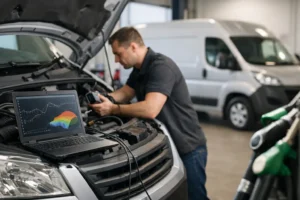
A DPF warning light has a habit of appearing at the worst possible time – on the school run, before a job, or halfway through a working week when your van cannot be off the road. That is exactly why mobile DPF cleaning Manchester services have become so popular. For many drivers, getting the right specialist to come to the vehicle makes far more sense than arranging recovery, losing a day at a garage, and still not knowing whether the filter is actually the real problem.
The key point is this: a blocked DPF is often a symptom as much as a fault in its own right. If the filter has loaded up with soot, there is usually a reason. Short journeys, failed regeneration, faulty sensors, EGR issues, boost leaks, injector problems, and AdBlue-related faults can all play a part. So if you are comparing options, the question is not just whether mobile cleaning is convenient. It is whether the person turning up knows how to diagnose the cause properly before anyone starts making promises.
When mobile DPF cleaning in Manchester makes sense
For the right vehicle and the right fault, mobile cleaning is a practical fix. It suits drivers whose diesel car or van is still fundamentally healthy but has reached the point where normal regeneration is no longer enough. You may have noticed reduced power, poor fuel economy, an engine management light, a DPF warning, or the cooling fan running on after journeys. In many cases, those are the signs of a filter carrying too much soot and struggling to clear itself.
If the vehicle still starts, runs, and can be diagnosed on site, mobile service is often the least disruptive route. That matters if you rely on your vehicle for work around Manchester, Salford, Rochdale, Bury, Bolton, Stockport, Wigan or Wilmslow. Tradespeople, delivery drivers, commuters and small business owners usually do not want the extra delay and cost that comes with booking into a workshop for something that may be resolved at home or at the workplace.
Mobile cleaning also makes sense when you have already had vague advice from elsewhere. Plenty of owners are told they need a new DPF when the picture is not that simple. Sometimes the filter is recoverable. Sometimes the problem is a failed pressure sensor or temperature sensor giving false readings. Sometimes the vehicle has tried to regenerate repeatedly, but another fault has stopped the process finishing. A proper on-site assessment can stop you spending money in the wrong place.
What a proper mobile DPF service should actually involve
There is a big difference between specialist DPF work and someone simply arriving with a scanner, clearing codes, and hoping for the best. A decent service starts with fault finding, not guesswork.
That means checking fault codes properly, reading live data, looking at soot load and differential pressure readings, and understanding how that ties in with the way the vehicle is behaving. If a van has a severe blockage but also has a split boost hose, an EGR fault or injector issue, cleaning the filter alone may only give temporary relief. The warning light can come back quickly because the root cause is still there.
A proper specialist will also tell you when mobile cleaning is not the right answer. That honesty matters. If the DPF is physically damaged, heavily contaminated with ash, melted internally, or the vehicle has underlying engine faults causing excessive soot production, the right advice may be different. Not every blocked filter should be cleaned on a driveway, and not every customer should be sold the same job.
That practical, case-by-case approach is what separates experienced operators from generic mobile services and call-centre booking firms. With diesel emissions systems, there is no shortcut around experience.
Why DPF problems are common in Manchester driving
Manchester traffic is not ideal for modern diesels. Stop-start journeys, congestion, short commutes and low-speed urban use all make life harder for a DPF. These filters need the right exhaust temperatures to regenerate properly. If your driving pattern rarely allows that to happen, soot builds up over time until the vehicle starts complaining.
That does not mean diesel is automatically the wrong choice for city drivers, but it does mean the system needs more attention. A lot of owners only realise how sensitive the setup is when the first warning light appears. By then, the car may have already attempted several failed regenerations, diluted the engine oil, or dropped into reduced performance mode.
This is especially common with European diesel cars and vans used for mixed local work. The van that spends all day moving around Greater Manchester might cover plenty of miles, but if those miles are mostly short hops and traffic queues, the DPF still suffers. The same applies to private cars used for school runs, shopping trips and commuting across town.
The trade-off between cleaning and replacement
This is where straight answers matter. Cleaning is usually far cheaper than replacing a DPF, sometimes by a large margin. It can also save time and avoid the hassle of sourcing parts. But cleaning is not a magic fix for every failure.
If the DPF is blocked mainly with soot and the rest of the system is in reasonable shape, cleaning can be the sensible option. If the filter is at the end of its life due to ash accumulation, or if the engine is producing more soot than it should because of another fault, then cleaning may only buy time. That does not make it pointless, but it does change the conversation.
The best advice is usually based on actual data from your vehicle rather than assumptions. Anyone saying every DPF can be saved is overselling it. Anyone saying every blocked DPF needs replacing is doing the same in the opposite direction.
Why mobile service suits working drivers
Convenience is not just about comfort. For many owners, it is about keeping the week on track. If your van is your livelihood, losing it for a day or two can cost more than the repair itself. If your car gets the family to work, school and appointments, arranging transport while a garage “has a look” is a headache you do not need.
That is why local mobile specialists are often the better fit. The vehicle can be checked where it is. The diagnosis is direct. You speak to the person doing the work, not a receptionist relaying messages between you and a workshop. There is also more accountability when the service is genuinely local and carried out by the business itself.
For customers across Greater Manchester, that local approach matters. You are not dealing with a faceless national outfit that books jobs and sends whoever is available. You want someone who understands these systems, knows the common faults on the vehicles seen in this area, and has enough hands-on time to spot when a DPF issue is really something else.
How to tell if you need specialist help now
If the warning light is on once and the vehicle still drives normally, some owners leave it and hope for the best. That can work if the car soon completes a proper regeneration. But if the light stays on, the vehicle feels flat, fuel use has worsened, or there are repeated warnings, it is time to stop guessing.
The same goes for vans entering limp mode, cars showing repeated engine management faults, or diesels that have already been to another garage without a clear answer. Delay often makes the job more expensive. A filter that might have been recoverable at an earlier stage can become a much bigger issue if the vehicle keeps being driven with regeneration problems.
This is also where experience with related diesel systems helps. DPF faults do not always appear on their own. AdBlue issues, NOx sensor faults, EGR problems and poor running can overlap, particularly on newer diesels. A specialist who works with those systems every day is more likely to get to the bottom of it quickly.
TechTuning Northwest sees that pattern regularly – vehicles that have been misdiagnosed, given inflated replacement quotes, or had parts fitted without fixing the actual cause. Good DPF work is not about selling the biggest invoice. It is about understanding what the vehicle is telling you and dealing with the problem properly.
If your diesel is showing DPF symptoms, the sensible next step is not to panic and it is not to keep driving until it gets worse. It is to get it checked by someone who knows these systems inside out, tells you the truth about your options, and can do the job without turning your week upside down.