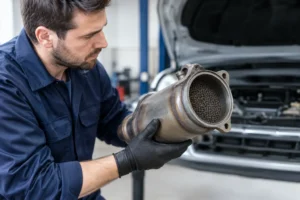
A DPF warning light does not automatically mean the filter needs replacing. But does DPF cleaning last? It can, provided the blockage is dealt with properly and the fault that caused it is not left behind. A clean DPF fitted back onto a vehicle with a failed sensor, EGR fault or injector problem will soon be back where it started.
Does DPF cleaning last?
A properly cleaned diesel particulate filter can last for many thousands of miles and, in the right circumstances, for the remaining useful life of the vehicle. There is no honest fixed mileage figure, because the result depends on the condition of the filter, how it was cleaned and, most importantly, why it blocked in the first place.
The DPF traps soot from the exhaust. During a successful regeneration, the engine management system raises exhaust temperatures and burns that soot away. What remains is ash – a non-combustible residue from engine oil additives and normal combustion. Over time, ash fills the small channels inside the filter and reduces its capacity.
A long motorway run may help a filter complete a regeneration if it is simply soot-loaded. It will not remove a significant ash build-up. Equally, a quick chemical treatment may help with light contamination, but it is not always enough for a heavily restricted filter. The cleaning method needs to match the condition of the DPF.
What determines how long a cleaned DPF stays clear?
The biggest factor is whether the vehicle can regenerate normally after cleaning. If it cannot, the soot load will return. This is why simply clearing fault codes or forcing a regeneration without checking the underlying data often produces a short-lived result.
The reason the DPF blocked
Short, low-speed journeys are a common cause. A diesel used for school runs, city commuting or stop-start local work may repeatedly interrupt active regenerations before they finish. The soot level gradually rises until the warning light appears and, eventually, the car may enter reduced-power mode.
However, driving pattern is only part of the picture. A DPF can block quickly because of a faulty differential pressure sensor, split or blocked pressure pipes, an exhaust temperature sensor reading incorrectly, an EGR valve fault, boost leak, injector issue or thermostat that prevents the engine reaching proper operating temperature. These faults can stop regeneration or make the engine produce more soot than it should.
Oil level matters as well. Repeated failed regenerations can lead to diesel fuel dilution in the engine oil. If the oil level is above the maximum mark, it should not be ignored. Continuing to drive with diluted oil can cause further engine problems, not just another DPF warning.
The cleaning process used
There is a difference between helping a restricted DPF regenerate and cleaning a filter that is loaded with ash. An on-vehicle cleaning treatment can be useful in suitable cases, particularly where the restriction is not severe and the rest of the system is healthy. It is less likely to provide a lasting answer where ash has accumulated heavily or the filter has suffered internal damage.
For a more heavily contaminated filter, removal and specialist off-vehicle cleaning can remove far more ash and residue from the DPF channels. Before refitting, the filter should be inspected for cracks, melted substrate or other damage. Cleaning cannot repair a broken core.
The best result is not merely a warning light that stays off. It is a lower differential pressure reading, sensible soot and ash values where the vehicle reports them, and evidence that the vehicle can complete a regeneration afterwards.
How the vehicle is used afterwards
Once the fault is resolved and the DPF is clean, the vehicle still needs opportunities to regenerate. That does not mean taking it for an unnecessary hard drive every week. It means recognising that a diesel which only ever does short trips may not suit the way it is being used.
A regular uninterrupted run at normal road speeds can help a healthy system complete regeneration. If a regeneration is clearly in progress – often shown by a higher idle speed, cooling fan operation, slightly increased fuel use or stop-start being unavailable – avoid switching off immediately if it is safe and practical to continue driving.
Signs that DPF cleaning may not last
If the DPF light returns within days or a few hundred miles, assume there is still a problem until proven otherwise. Another regeneration may temporarily reduce the soot load, but it does not explain why it built up so fast.
Common signs of an unresolved issue include frequent regeneration attempts, poor fuel economy, cooling fans running after the ignition is switched off, a rising engine oil level, reduced performance and engine management faults alongside the DPF warning. Some vehicles also display messages such as particulate filter full, drive to clean filter, or emissions fault.
The fault code alone is not the diagnosis. A code relating to DPF efficiency, pressure or soot loading can be triggered by the filter itself, its sensors, the pressure hoses or an engine fault upstream. Live diagnostic readings are what separate a sensible repair from expensive guesswork.
When cleaning is the right option – and when it is not
Cleaning is often a sound alternative to DPF replacement where the filter substrate is intact and the restriction is caused by soot and ash. It can make particular sense on a van or car that has accumulated mileage but is otherwise in good condition.
It may not be the right answer if the DPF is cracked, melted, contaminated beyond recovery or repeatedly blocked because of an unrepaired mechanical fault. In those cases, cleaning the filter first may only delay the proper repair. A replacement may be needed, but it should be based on inspection and measured readings rather than a warning light alone.
Be cautious with forced regeneration too. It has its place when diagnostic checks show the DPF is within safe limits and the cause of the blockage has been addressed. Forcing a regeneration on an excessively loaded filter, or one affected by a sensor or fuelling fault, can create very high exhaust temperatures and risks damaging the DPF further.
A proper DPF diagnosis before spending money
A useful DPF assessment starts with a full vehicle scan, but should not end there. The technician should check stored and pending faults, soot load, calculated ash load where available, differential pressure readings at idle and at raised engine speed, exhaust temperature sensor values and the vehicle’s regeneration history.
Pressure pipes deserve close attention. On many European diesels, small pipes running to the differential pressure sensor can become blocked with soot, split with age or fill with moisture. A false pressure reading can make a healthy DPF look blocked, or allow a genuinely blocked one to be missed.
The engine also needs checking for the reasons it may be producing excess soot. Depending on the vehicle, that can include EGR operation, air intake and boost control, injector performance and coolant temperature. There is little value in restoring DPF flow if the engine is still sending abnormal levels of soot into it.
For drivers around Greater Manchester who need this assessed without losing a day at a garage, Tech Tuning Northwest provides mobile diesel diagnostics and can identify whether cleaning, regeneration work or a separate repair is the sensible next step.
Questions drivers often ask
Can I drive with a DPF warning light on?
For a short period, possibly, but it is not something to leave. If the warning is accompanied by reduced power, a flashing glow plug light, an engine management light or a message telling you not to continue, arrange diagnosis promptly. Continuing to drive can turn a cleanable filter into a more costly repair.
Will motorway driving clean the DPF?
It can help a vehicle complete an active regeneration if the system is working and the soot loading is still moderate. It will not remove ash, repair a failed pressure sensor or overcome an EGR, injector or temperature-related fault.
How do I stop the DPF blocking again?
Address any fault first, use the correct low-ash engine oil for the vehicle, and avoid regularly interrupting regenerations where possible. If your normal use is almost entirely short journeys, respond early when the first warning appears rather than waiting for limp mode.
A DPF is not a disposable service item and a warning light is not a diagnosis. Deal with the cause while the filter is still recoverable, and cleaning has every chance of being a worthwhile, lasting repair rather than a temporary reset.