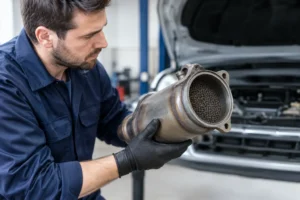
A Ford DPF pressure repair is often requested after a warning light appears, the engine loses power or a garage quotes for a new particulate filter. But the DPF itself is not always the failed part. On many Ford diesels, the fault lies with the differential pressure sensor, its pipes, an electrical connection or an interrupted regeneration process. Replacing parts before proving the cause is how a manageable repair turns into an expensive one.
What DPF pressure means on a Ford
Your diesel particulate filter, or DPF, collects soot from the exhaust. To work out how full it is, the engine ECU monitors the pressure before and after the filter. It does this through a differential pressure sensor, usually connected to the exhaust by two small pipes or hoses.
A clean, freely flowing DPF produces a relatively small difference between the pressure on each side. As soot builds up, exhaust flow becomes more restricted and the pressure difference rises. The ECU uses this information, alongside exhaust temperature, driving conditions and calculated soot load, to decide when a regeneration is needed.
During an active regeneration, the engine raises exhaust temperature to burn collected soot into a small amount of ash. Ash does not burn off, so even a correctly maintained DPF has a finite service life. However, a faulty pressure reading can make the ECU believe the filter is blocked when it is not, or fail to recognise a genuinely loaded filter.
This is why pressure data needs interpreting properly. A single fault code does not automatically mean the DPF requires replacement.
Symptoms that point to a Ford DPF pressure fault
The most obvious sign is an engine management light, often accompanied by a DPF warning message or reduced power. On some models, particularly Ford Transit vans used for local work, the vehicle may enter limp mode to protect the engine and exhaust system.
Other common symptoms include frequent attempted regenerations, increased fuel consumption, an engine cooling fan running after the ignition is switched off, uneven idle, or a noticeable smell from the exhaust after a journey. If repeated regenerations have been unsuccessful, the oil level can rise because diesel fuel used during regeneration finds its way past the piston rings. That should not be ignored, as diluted oil can cause serious engine damage.
The symptoms vary between vehicles. A Mondeo, Focus, Kuga, Ranger or Transit with a TDCi diesel engine may show similar warnings, but the reason behind them can be different. Vehicle use matters too. A van doing short stop-start runs around Greater Manchester is far more likely to struggle with regeneration than one regularly completing longer motorway journeys.
Common fault codes and what they really suggest
Diagnostic codes give a starting point, not a repair instruction. Ford DPF pressure-related faults commonly include P2452, P2453 and P2454, which generally relate to the DPF differential pressure sensor circuit or its signal. A code may indicate that the signal is implausible, too high, too low, or outside its expected range.
Codes such as P2463 can indicate excessive soot accumulation, while P2002 often points to DPF efficiency below the expected threshold. These can be caused by a genuinely restricted filter, but they can also appear when pressure readings are wrong or when another engine fault has created excess soot.
For example, an EGR issue, boost leak, injector fault, failed temperature sensor or air-flow problem can alter combustion and fill the DPF faster than normal. Clearing the code and forcing a regeneration without dealing with the underlying cause can bring the warning straight back.
The causes behind a failed pressure reading
The pressure sensor is a common failure point, but it is not the only one. Its position near a hot exhaust system exposes it to heat, moisture and vibration. Internal electronic failure is possible, especially on higher-mileage vehicles.
More often, the pipes leading to the sensor are blocked with soot or contaminated with moisture. One pipe may split, rub through, collapse internally or become disconnected. If the pipes are fitted to the wrong ports after previous work, the sensor can report the pressure difference backwards. This can create confusing live data and unsuccessful regeneration attempts.
Electrical faults also need checking. Corroded pins, damaged wiring near the sensor connector and poor earth connections can cause intermittent readings. A sensor may appear to work at idle but fail as exhaust pressure rises under load.
There is also a less obvious issue: the sensor can be accurate, but the DPF can be genuinely overloaded. This is especially likely where the warning has been ignored for weeks, the vehicle has only done short journeys, or a separate fault has prevented regenerations. The correct repair depends on which of these conditions is present.
How Ford DPF pressure repair should be diagnosed
Proper diagnosis begins with a full fault-code scan, including stored, pending and historic faults. The technician should then look at live data rather than relying solely on the dashboard warning. Relevant readings include DPF differential pressure, calculated soot load, ash load where available, exhaust temperatures, regeneration status and distance since the last successful regeneration.
The pressure reading should make sense with the engine switched off, at idle and as engine speed rises. An implausibly high reading with the engine off can suggest a sensor or wiring fault. A reading that barely changes as revs increase can point to blocked or damaged pipes. Conversely, a very high reading under load may support the diagnosis of a physically restricted DPF.
The sensor pipes should be removed and inspected carefully. This is not just a quick glance from above. Both pipes and their exhaust take-off points need checking for soot blockage, cracks and heat damage. The connector and wiring should also be tested rather than assumed to be sound.
If the DPF is genuinely loaded, the next step is to establish why. A forced regeneration can be appropriate only when live readings, temperatures and engine condition show it is safe. It is not suitable for every vehicle. If the filter is excessively blocked, damaged or contaminated with oil or coolant, forcing a regeneration can overheat the exhaust system and create further problems.
Repair options: sensor, pipes, cleaning or replacement
A straightforward Ford DPF pressure repair may involve replacing a failed differential pressure sensor and renewing damaged or blocked pressure pipes. The ECU may then need fault codes cleared and learned values reset or recalibrated, depending on the model and repair carried out. This work should be followed by a road test and live-data check to confirm that readings now behave normally.
Where the DPF is loaded with soot but structurally sound, a controlled regeneration or professional cleaning may be the sensible option. Cleaning can remove soot and, depending on the process, reduce accumulated ash. It is not a cure for a cracked filter substrate or a vehicle that is continually producing excessive soot.
Replacement is sometimes unavoidable, particularly when the filter is damaged, heavily ash-loaded or contaminated beyond recovery. Even then, fitting a new DPF without correcting the cause of the original blockage risks repeating the failure. A new filter will not fix a faulty EGR valve, leaking boost hose, injector issue or failed pressure sensor.
When to stop driving and get it checked
Do not continue using the vehicle as normal if it is in limp mode, showing a red warning, producing excessive smoke, or if the oil level has risen above the maximum mark. Avoid repeated high-speed runs in the hope that the vehicle will clear itself if there is already a pressure sensor fault or a heavily loaded DPF. The engine may attempt regenerations that cannot complete properly.
If the warning has only just appeared and the vehicle drives normally, a prompt diagnosis is still the sensible move. Catching a split pressure hose or failed sensor early is usually far cheaper than allowing soot loading to rise until the DPF, oil and turbocharger are all at risk.
For Ford owners who need a clear answer rather than a parts-changing guess, Tech Tuning Northwest provides mobile diesel diagnostics across Greater Manchester. The focus is on checking the fault, live values and underlying cause before recommending the repair.
A DPF warning does not always mean a new DPF. Get the pressure system tested properly, act before repeated failed regenerations cause further damage, and you stand a far better chance of keeping the repair proportionate.