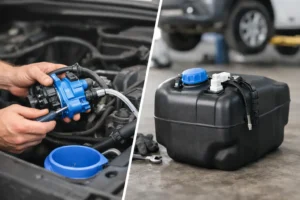
A DPF warning light does not automatically mean the filter needs replacing. In many cases, drivers searching how to force DPF regeneration have a vehicle that has stopped completing its normal cleaning cycle. A properly carried out forced regeneration can clear accumulated soot and get the vehicle back to normal. Done at the wrong time, however, it can overheat the exhaust, fail part way through, or hide the actual fault.
The key is to establish whether the DPF is genuinely suitable for regeneration before commanding one. That means reading live data, not simply clearing a fault code and hoping for the best.
What a forced DPF regeneration actually does
A diesel particulate filter traps soot from the exhaust. During normal driving, the engine management system periodically raises exhaust temperature to burn that soot into a small amount of ash. This is known as active regeneration. Longer steady runs at motorway speeds can also help the system complete its cycle.
A forced regeneration is different. Using suitable diagnostic equipment, a technician instructs the ECU to start a stationary or workshop-controlled regeneration. The engine runs at increased speed while the exhaust temperature rises significantly, often well above 500°C. The aim is to reduce the calculated and measured soot load in the DPF.
It is not a magic reset, and it does not remove ash. Ash is the non-combustible residue left after many regeneration cycles, usually from fuel and oil additives. A filter with high ash loading may need professional cleaning or replacement even if a forced regeneration completes successfully.
When should you force DPF regeneration?
A forced regeneration is appropriate when the DPF is soot-loaded but still within the manufacturer’s safe limits, and the underlying conditions for regeneration have been checked. This often applies where a driver has made repeated short trips, interrupted a regeneration by switching off, or continued to use the vehicle after an early DPF warning appeared.
Typical symptoms include a DPF or engine warning light, reduced performance, increased fuel consumption, cooling fans running after the ignition is switched off, and a higher-than-usual idle speed. Some vehicles enter limp mode and limit power until the issue is addressed.
It depends on the vehicle and the fault codes stored. A Volkswagen, Audi, BMW, Mercedes, Peugeot, Citroën, Ford or Vauxhall diesel may all report DPF trouble differently, but the principle is the same: the ECU must see believable readings from the sensors and must be able to control the conditions needed to generate heat.
A forced regeneration is usually not suitable if the soot load is critically high, the oil level is overfilled with diesel-contaminated oil, there is an active engine fault, or the differential pressure readings suggest a seriously blocked filter. In those situations, forcing more heat through the system can make an expensive problem worse.
How to force DPF regeneration safely
The safe answer is that a forced regeneration should be carried out with professional diagnostic equipment by someone who understands the live data and safety procedures. It is not the same as using a basic code reader or buying a bottle of additive.
Before starting, a proper diagnosis checks the DPF soot calculation, differential pressure, exhaust gas temperature sensors, coolant temperature, fuel level, battery voltage and any related engine fault codes. The technician should also inspect for exhaust leaks, split pressure sensor pipes, failed sensors, boost faults, EGR faults and injector problems. Any of these can prevent a normal regeneration or cause it to fail.
The vehicle is then positioned outdoors, clear of grass, buildings, other vehicles and anything combustible. Exhaust components become extremely hot during the procedure. The engine may run at elevated revs for 20 to 40 minutes, depending on the make, model and soot load. Cooling fans may operate at full speed, and the process should be monitored throughout using live diagnostic data.
If temperatures, pressure readings or engine behaviour become unsafe, the regeneration should be stopped. Once complete, the soot level and differential pressure should be checked again rather than assuming the warning light tells the whole story. Relevant fault codes can then be addressed correctly and the ECU adaptations reset only where the manufacturer procedure calls for it.
Why a forced regeneration can fail
A failed forced regeneration is useful diagnostic information. It often means the DPF itself is not the root cause.
One common issue is a faulty DPF differential pressure sensor or its pipes. The sensor compares exhaust pressure before and after the filter. If it reports an implausibly high value, the ECU may believe the DPF is blocked even when it is not. Conversely, a false low reading can allow soot to build up unnoticed.
Exhaust temperature sensors are equally important. The ECU needs accurate temperatures before, during and after the DPF to control fuelling safely. If a sensor is reading incorrectly, regeneration may be inhibited or aborted.
EGR faults, boost leaks, damaged injectors, thermostat faults and poor combustion can all increase soot production. On some diesels, a failed glow plug or glow plug control module can prevent regeneration even though the vehicle starts and drives normally. If the cause remains, a freshly regenerated DPF can block again within days or weeks.
Short journeys are often part of the story, particularly for commuters and van owners doing local work. But they are not always the full explanation. A healthy vehicle that gets the occasional sustained run should generally manage its DPF system. Repeated warning lights deserve diagnosis, not another hopeful motorway journey.
Can you regenerate the DPF by driving?
If the warning is at an early stage and there are no other faults, a sustained drive may allow an active regeneration to complete. Follow the vehicle handbook first. As a general guide, drive once the engine is fully warm at a steady speed for around 20 to 30 minutes, ideally on a clear dual carriageway or motorway. Avoid stop-start traffic and avoid switching off midway through if the vehicle is clearly in the middle of a regeneration.
This is not suitable for every warning light. If the DPF light is flashing, the engine management light is on, power is restricted, or the vehicle displays a message saying regeneration is not possible, do not keep driving it hard in the hope that it will clear. The soot level may already be beyond the point at which the ECU will attempt a normal regeneration.
Forced regeneration, DPF cleaning or replacement?
These are three different repair options. Forced regeneration burns off soot and is often the least intrusive solution where the filter is fundamentally sound. Professional DPF cleaning is more suitable where ash or stubborn deposits have accumulated and the filter needs to be removed or cleaned using the correct process. Replacement is generally the last option, used where the filter has melted, cracked, is physically damaged or cannot be restored.
Be wary of anyone promising that every blocked DPF can be fixed with a quick reset. Clearing the warning light without reducing the blockage or correcting the cause simply delays the problem. It can also lead to excessive back pressure, turbocharger trouble, oil dilution and a vehicle that eventually will not complete regeneration at all.
For drivers in Greater Manchester who rely on a diesel car or working van, mobile diagnosis can be particularly useful. Tech Tuning Northwest checks the fault codes and live readings first, then recommends the repair that fits the actual condition of the vehicle rather than selling a replacement DPF by default.
A DPF warning is best dealt with early, while the system still has safe options available. Get the figures checked, fix what is preventing regeneration, and let the vehicle tell you what it needs rather than relying on a dashboard light alone.