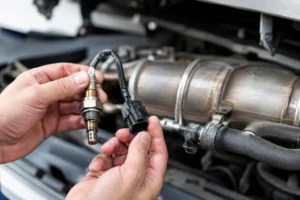
A DPF warning light is rarely just a reminder to take the car for a fast run. For some drivers, that may be enough. For others, particularly those already seeing reduced power, repeated regeneration attempts or an engine management light, the problem needs diagnosing before any cleaning is attempted. This DPF cleaning guide explains what can realistically be cleaned, what causes a filter to block, and when cleaning is no longer the right answer.
What the DPF does and why it blocks
The diesel particulate filter, usually called the DPF, sits in the exhaust system. Its job is to trap soot created during normal diesel combustion before it leaves the tailpipe. Over time, the vehicle burns that soot away in a process called regeneration.
Passive regeneration happens naturally when exhaust temperatures stay high enough, often during a steady motorway or dual-carriageway journey. Active regeneration is controlled by the engine ECU. It adds extra fuel at the right point in the cycle to raise exhaust temperature and burn soot from the filter.
The issue is that neither process works well if a vehicle is used mainly for short, slow journeys. School runs, stop-start commuting, local deliveries and site-to-site van work can all interrupt active regenerations before they finish. Soot then builds up until the DPF reaches a calculated blockage level and brings on a warning light.
A blocked DPF is not always caused by the DPF itself. Faulty temperature sensors, a damaged differential pressure sensor, split pressure hoses, EGR faults, boost leaks, injector problems and thermostat faults can all prevent regeneration or make the engine produce too much soot. This is why fitting a new filter, or cleaning the existing one, without checking the underlying fault can become an expensive repeat repair.
DPF cleaning guide: know soot from ash
The most useful distinction is between soot and ash. Soot is combustible carbon and, provided the system is healthy, regeneration can remove it. Ash is the non-combustible residue left from engine oil additives and general engine wear. Regeneration will not burn ash away.
As a DPF ages, its ash load rises even if the vehicle regularly completes regenerations. A high-mileage diesel that has been looked after can still reach the point where the filter has too little internal capacity left. Chemical or off-car cleaning may remove a substantial amount of ash, depending on the method and the filter’s condition, but a cracked, melted or contaminated DPF cannot be restored by a bottle of cleaner.
The ECU does not directly measure soot inside the filter. It estimates soot loading from driving conditions, fuel use and sensor readings, then compares this with exhaust pressure. Incorrect sensor data can therefore make a healthy filter look blocked, or allow a genuinely blocked one to go unnoticed for too long.
Signs your DPF needs attention
The first warning is commonly an amber DPF light. If it appears on its own and the vehicle is otherwise driving normally, a sustained drive at normal road speed may allow a regeneration to complete. Follow the handbook where possible, use the correct fuel level, and avoid repeatedly switching the engine off during the journey.
Do not assume this will work in every case. An engine management light, glow plug light, limp mode or message stating that the filter is full usually means the vehicle has moved beyond a simple driving regeneration. Some Volkswagen Group models show a flashing glow plug light, while BMW, Mercedes, Ford, Vauxhall, Peugeot and Citroen diesels may use different messages or fault-code strategies. The principle is the same: the car has detected a condition that may stop normal regeneration.
Other common symptoms include poor acceleration, reduced fuel economy, a cooling fan running after the engine is switched off, a higher idle speed, a strong hot smell and oil level rising on the dipstick. Rising oil level needs taking seriously. Repeated interrupted regenerations can allow diesel fuel to dilute the engine oil, reducing its protective qualities.
When a motorway run can help
A proper drive can be worthwhile when the DPF light has only just appeared, there are no other warning lights, the engine reaches normal operating temperature and the vehicle is not in reduced-power mode. A continuous 20 to 30 minutes at a legal, steady speed gives the ECU the best chance of completing a regeneration.
It is not a cure for a filter that is heavily loaded, nor does it fix a sensor or EGR fault. Revving a cold engine on a driveway, or taking repeated short high-rev runs, will not clean a DPF properly and can create further problems. If the warning returns shortly after a successful-looking drive, the car needs fault-code reading and live-data checks rather than more guesswork.
Cleaning methods and their limits
In-tank additives
Fuel additives are often the cheapest option. Some can lower the temperature at which soot burns and may support a normal regeneration where the blockage is mild. They are not a repair for a full DPF, a failed sensor, excessive ash or an engine fault. Treat them as occasional support, not a substitute for diagnosis.
On-vehicle chemical cleaning
Professional on-vehicle cleaning introduces a cleaning solution through an appropriate sensor or pressure connection, then uses controlled regeneration where the vehicle and readings allow it. It can be effective when soot and moderate deposits are restricting flow, without the labour of removing the DPF.
The quality of this work depends on the pre-checks. Differential pressure readings, exhaust temperature sensor values, fault codes, calculated soot load and the reason the DPF blocked should be assessed first. Cleaning a filter while an injector is over-fuelling or an EGR valve is stuck is unlikely to produce a lasting result.
Off-car DPF cleaning
For a filter with a high ash load, off-car specialist cleaning is often more thorough. The DPF is removed and cleaned using equipment designed to flush and test its flow. This can be a sensible middle ground between an on-car treatment and replacement, but removal labour and the condition of the unit need to be considered.
Replacement
Replacement is sometimes unavoidable. A DPF with a damaged substrate, internal melting, physical cracks or contamination from coolant or excessive oil consumption may not be safe to clean. A quality replacement fitted after the original cause has been corrected is far better value than repeatedly cleaning a failed unit.
Removing or hollowing out a DPF is not a legitimate repair. It can create MOT, insurance and emissions problems, and it leaves the original engine fault unresolved.
Why forced regeneration is not a first step
A diagnostic forced regeneration raises exhaust temperatures significantly to burn off soot. Done at the right time, with correct readings and no underlying faults, it can be useful. Done to an overfull or damaged filter, it risks extreme exhaust heat, DPF damage and, in serious cases, a fire risk.
Before commanding one, a technician should check oil level and condition, cooling system operation, fault codes, sensor plausibility and differential pressure. The vehicle also needs a suitable safe area. A forced regeneration is a controlled procedure, not a button to press because a warning light is inconvenient.
What a proper diagnosis should include
A meaningful DPF diagnosis is more than plugging in a generic code reader. Fault codes are the starting point, not the verdict. Live data should show pressure before and after the DPF, exhaust gas temperatures, calculated soot and ash figures, regeneration history, engine temperature and the status of related systems.
On European diesels, the DPF often depends on several emissions components communicating correctly. A NOx sensor or SCR fault may not physically block the filter, but faults elsewhere can affect operating strategy. Likewise, an EGR problem can raise soot output, and a thermostat stuck open can stop the exhaust reaching the conditions needed for regeneration.
For owners who rely on a van or car for work, the goal is not merely to clear the dashboard message. It is to establish whether the DPF can regenerate, whether cleaning is appropriate, and what needs fixing so the same warning does not return next week.
Tech Tuning Northwest carries out diesel emissions diagnosis and DPF fault investigation across Greater Manchester, including mobile appointments where suitable. That approach is particularly useful when a vehicle is in limp mode or a busy owner cannot leave a van at a garage all day.
A DPF warning light is best dealt with early, while the filter still has a realistic chance of recovering. The right repair starts with the reason it blocked, not the most convenient-looking cleaning product.