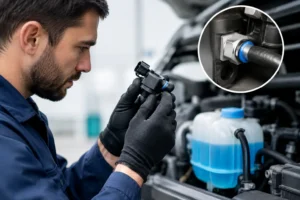
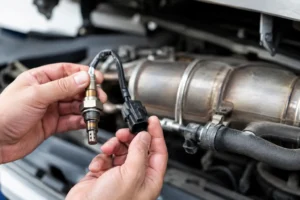
An AdBlue warning is not always an AdBlue problem. A dash message such as “Emissions fault”, “AdBlue system fault” or “No engine start possible in 650 miles” can be triggered by a sensor, wiring issue, poor pressure, an injector deposit or a fault elsewhere in the SCR system. Knowing how to diagnose AdBlue faults properly can save a great deal of money compared with replacing a tank or pump on guesswork.
The urgency depends on the message. Some warnings allow normal driving for a while, while a no-start countdown can eventually prevent the engine restarting once it reaches zero. Do not assume that topping up the tank will clear every warning. If the system cannot confirm that it is dosing AdBlue correctly, the fault remains even when the tank is full.
Start by understanding what the warning actually means
AdBlue is a urea-based fluid injected into the exhaust on many Euro 6 diesel cars and vans. It works with the Selective Catalytic Reduction, or SCR, system to reduce nitrogen oxide emissions. The engine control unit monitors the amount of fluid available, its quality, the pressure produced by the pump, injector operation and readings from the NOx sensors before and after the SCR catalyst.
A dashboard warning may relate to any part of that chain. This is why an AdBlue fault can appear on Audi, BMW, Citroën, Ford, Mercedes, Peugeot, Vauxhall, Volkswagen and many other diesels, but the underlying cause is not necessarily the same between models.
Before any testing, write down the exact wording of the warning, the remaining mileage if there is a countdown, and when it appeared. Did it start after the tank was filled? Is the engine in reduced power? Does the warning return immediately after being cleared? Those details help separate a simple level recognition issue from a genuine SCR performance problem.
Check the basics without creating a second problem
If the AdBlue level is genuinely low, use fresh fluid that meets ISO 22241 specification. Avoid using an old, unsealed container that has been stored through hot summers or freezing winters. AdBlue can degrade or become contaminated, and it must never be mixed with water, diesel or additives.
Fill only through the AdBlue filler point and clean any spills with water. The fluid can crystallise as it dries, leaving a white residue around the filler or under the vehicle. Crystals around an injector or pipe connection can be a useful clue, but they do not prove which component has failed.
After a top-up, some vehicles need enough fluid added before the level sensor registers a change. Adding a litre when the system expects a larger quantity may not reset a low-level warning. However, repeatedly adding more fluid to a full tank will not cure an SCR fault and risks overfilling the system.
Read fault codes with proper diagnostic equipment
A generic code reader can be useful, but it often gives only part of the story. Proper diagnosis requires equipment that communicates with the engine ECU and, where fitted, the manufacturer-specific SCR or emissions control modules. Live data matters as much as the stored code.
Common codes can point the investigation in the right direction:
- P204F commonly indicates a reductant system performance fault.
- P20E8 often relates to low AdBlue pressure.
- P20EE usually means the SCR system is not reducing NOx emissions efficiently.
- P2200, P2201 and related codes can indicate a NOx sensor circuit or range issue.
- P203B and similar codes may concern the AdBlue level sensor or tank assembly.
The wording varies by manufacturer, and one code is not a diagnosis on its own. For example, P20EE may be caused by a failing NOx sensor giving implausible readings, insufficient injection from a blocked injector, low pump pressure, poor-quality fluid, an exhaust leak or a catalyst issue. Replacing the SCR catalyst first would be an expensive gamble.
A capable diagnostic session checks freeze-frame data too. This shows the conditions present when the ECU recorded the fault, including engine temperature, vehicle speed, NOx readings and dosing status. A fault that appears only after a long motorway run can require a different line of enquiry from one that returns immediately on a cold start.
Use live data to test the SCR system in order
The sensible way to diagnose AdBlue faults is to test the system from the tank to the exhaust, rather than jumping straight to the most expensive part. First, check the reported AdBlue level, temperature and quality where the vehicle provides these values. An implausible level reading on a full tank can point to an internal tank sensor issue, though wiring and module communication should be checked first.
Next, assess the pump and pressure circuit. Many vehicles can run an actuator test that commands the pump and measures whether pressure builds and holds. Low pressure can be caused by a weak pump, a leak in a line, a blocked filter, crystallisation, a faulty heater or a pressure sensor reporting incorrectly. On several models, the pump, heater and sensors are integrated into the tank, which affects the repair options and cost.
The injector needs checking as well. It sits in a very hot part of the exhaust and can become restricted by crystals. A technician can inspect it for deposits and, where the diagnostic process permits, carry out a controlled dosing test. Never remove or test an injector on a hot exhaust, and do not run improvised tests with AdBlue fluid. It is a pressurised system and the ECU must control dosing accurately.
Finally, compare upstream and downstream NOx sensor readings under the correct operating conditions. The readings should respond sensibly as the system begins dosing. A sensor can look electrically connected yet still provide slow, fixed or implausible values that lead the ECU to blame the AdBlue system.
Look for causes outside the AdBlue tank
SCR faults are often diagnosed too narrowly. Exhaust leaks before or around the SCR catalyst can affect sensor readings and conversion efficiency. Damaged wiring near the exhaust is common because of heat, road spray and vibration. Corroded connectors, particularly around underbody sensors and tank connections, can cause intermittent faults that disappear during a quick garage check.
Engine-related faults matter too. A DPF that cannot regenerate correctly, an EGR problem or excessive soot production can alter exhaust temperatures and emissions readings. The vehicle may log an SCR efficiency code even though the main fault started elsewhere. That does not mean every AdBlue warning is caused by the DPF or EGR, but it is why a full scan of relevant modules is better than clearing one code and hoping for the best.
Short journeys can contribute on some diesels. The system needs suitable exhaust temperature and driving conditions to complete certain checks. A vehicle used mainly for brief local runs may not complete its monitoring routine, making a marginal component more likely to trigger a warning. Equally, a fault that returns after a proper sustained drive should not be dismissed as a journey-pattern issue.
Do not clear the code before the evidence is recorded
Clearing fault codes too early removes valuable freeze-frame information and may reset monitoring tests temporarily. The warning can stay off for a few journeys, then return once the ECU runs its checks again. This is one reason some vehicles seem fixed after a quick scan, only for the no-start countdown to come back days later.
If a repair has been carried out, the vehicle may need a guided reset, pump priming routine, adaptation or SCR efficiency test. The exact procedure depends on the make and model. Simply deleting codes is not the same as confirming the repair.
Do not be tempted by AdBlue delete software, emulator boxes or physical modifications. Aside from being unlawful for road use, they can create further ECU faults, inspection problems and costly complications when the vehicle later needs proper repair.
When specialist diagnosis is the cost-effective choice
If a no-start countdown is active, the warning returns after a top-up, or a garage has proposed replacing the entire tank without explaining the test results, it is time for targeted diagnostics. A specialist should be able to explain which readings or tests support the recommended repair, whether wiring and sensors have been ruled out, and what needs resetting afterwards.
For drivers across Greater Manchester, Tech Tuning Northwest carries out mobile diesel diagnostics for AdBlue, SCR, NOx, DPF and ECU-related faults at home or work where practical. The aim is not to sell the largest part on the vehicle, but to establish why the ECU has raised the warning before recommending a repair.
The best next step is simple: keep the warning details, avoid running the countdown down to zero, and have the system tested while there is still enough time to make a measured repair rather than recover a vehicle that will no longer restart.