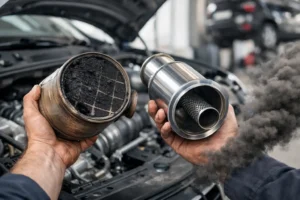
A dashboard message saying “AdBlue system fault” can quickly turn a normal commute or working day into a worry. The message may be followed by an engine warning light, a countdown showing how many miles remain before the vehicle will not restart, or reduced engine performance. This Euro 6 AdBlue system guide explains what the system does, why these faults happen and what a proper diagnosis should involve before anyone starts replacing expensive parts.
The most useful thing to know is that an AdBlue warning does not always mean the tank is empty, and topping it up does not cure every fault. Euro 6 diesel vehicles use several sensors, pumps, heaters, injectors and control systems to monitor emissions. One incorrect reading can trigger a warning, even when the engine itself is running perfectly well.
What the Euro 6 AdBlue system actually does
Euro 6 diesel cars and vans use Selective Catalytic Reduction, usually shortened to SCR, to reduce nitrogen oxide emissions from the exhaust. Nitrogen oxides, or NOx, are produced during diesel combustion and are harmful pollutants. The SCR system injects a measured amount of AdBlue into the exhaust, where heat converts it into ammonia. Inside the SCR catalyst, that ammonia reacts with NOx and turns it largely into harmless nitrogen and water vapour.
AdBlue is not a fuel additive. It is a solution of purified water and urea stored in a separate tank, normally accessed beside the diesel filler cap, under the bonnet or in the boot depending on the vehicle. The engine ECU calculates how much to inject based on exhaust temperature, engine load, NOx sensor readings and other data.
If the vehicle cannot confirm that the system is reducing NOx as required, it will log a fault. Euro 6 regulations require the manufacturer to apply a restart restriction if certain SCR faults are not rectified. That is why a seemingly minor emissions warning can become a “No engine start possible in 500 miles” message.
Why an AdBlue warning light comes on
A low AdBlue level is the simplest cause. Most vehicles give an early warning with enough range to refill the tank. Use AdBlue that meets ISO 22241 specification, avoid spilling it on paintwork, and do not store an opened container for long periods. Contamination, old fluid or filling the wrong tank can create far bigger problems than a low-level warning.
However, many warnings appear when the tank is already full. In real diagnostic work, the common causes tend to be a failed NOx sensor, a fault within the AdBlue tank module, a blocked or crystallised injector, a wiring problem, or an SCR catalyst efficiency issue.
NOx sensor faults
Most Euro 6 SCR systems have one NOx sensor before the SCR catalyst and another after it. They measure whether the exhaust treatment process is doing its job. These sensors operate in severe heat and can fail internally, suffer wiring damage or report implausible values.
A failed NOx sensor can make the ECU believe the vehicle is producing too much NOx, or that the SCR catalyst is not working, even though the actual AdBlue dosing equipment may be fine. Replacing an AdBlue pump or injector without checking sensor data first can be an expensive guess.
AdBlue tank, pump and heater problems
On many vehicles, the AdBlue tank contains more than fluid. It can include the pump, level sensor, temperature sensor, heater and electronic control unit. This makes the assembly technically complex and, on some models, costly to replace.
The tank heater matters because AdBlue freezes at around -11°C. The system is designed to thaw it when necessary, but a heater circuit fault can still trigger warning messages. Internal pressure faults, poor pump performance and inaccurate level readings are also common. A vehicle may show a full tank but still report that it cannot dose AdBlue correctly.
Crystallised AdBlue injector or pipework
AdBlue can crystallise into white deposits when it dries around the injector, pipe connections or filler neck. Small amounts of residue are not unusual, but heavy build-up can restrict dosing or affect the injector spray pattern.
Short journeys, repeated stop-start use and a leaking injector can make crystallisation worse. The answer is not always a new injector. The pipework, dosing position, injector operation and underlying reason for the leak should be checked. Simply cleaning visible crystals without testing the system can leave the original fault behind.
SCR catalyst efficiency faults
If the ECU sees little difference between the NOx reading before and after the SCR catalyst, it may log an efficiency fault. This does not automatically mean the catalyst has failed. Incorrect dosing, poor-quality fluid, an exhaust leak, a faulty sensor or wiring issue can all produce similar readings.
The catalyst itself can deteriorate, particularly on high-mileage vehicles or where a fault has been ignored for a long time. But it should be the conclusion of testing, not the starting point. A replacement SCR catalyst can be a substantial bill, so live data and system tests are essential before condemning it.
What the no-start countdown means
The restart countdown is one of the most frustrating parts of an AdBlue fault. It does not normally stop the engine immediately. You can usually continue driving until the displayed mileage reaches zero, but once the engine is switched off, the vehicle may refuse to start.
Do not treat the remaining mileage as a target to use up. It is time to arrange diagnosis while the vehicle is still mobile. If the countdown reaches zero on a driveway, work site or supermarket car park, the repair may become more awkward and may involve recovery.
Adding more AdBlue can reset a genuine low-level warning after the vehicle recognises the refill. It will not clear a sensor, pump, pressure, heater or catalyst fault. Nor will repeatedly clearing fault codes solve it. The ECU will run its checks again, and the warning or countdown will return if the underlying issue remains.
How an AdBlue fault should be diagnosed
A proper diagnosis starts with a full fault-code scan, but the code alone is not a final answer. Codes identify the circuit or system that has failed its test. They do not always identify the failed component.
For example, a code relating to poor SCR efficiency may be caused by a NOx sensor that is reporting incorrectly, insufficient AdBlue pressure, restricted dosing, a damaged exhaust section or a tired catalyst. The next step is to assess live data: AdBlue level and temperature, pump pressure where available, requested versus actual dosing, upstream and downstream NOx readings, exhaust temperatures and fault status.
Visual checks still matter. A technician should look for crystallisation, damaged wiring around the tank and exhaust, leaks, corroded connectors and signs that the wrong fluid has been used. On suitable systems, active tests can command the pump or injector and confirm how the vehicle responds.
This approach is particularly relevant on common European diesel cars and vans from Volkswagen Group, Mercedes-Benz, BMW, Peugeot, Citroën, Ford, Renault, Vauxhall and Jaguar Land Rover. The fault messages vary, but the logic is much the same: the ECU needs reliable sensor information and proof that the SCR system is reducing NOx.
Can you keep driving with an AdBlue system fault?
It depends on the message shown and how the vehicle is behaving. If there is only a low AdBlue warning and the vehicle accepts a correct refill, normal use may be fine. If there is an engine warning light, an emissions fault message or a restart countdown, it is sensible to limit unnecessary journeys and book diagnosis promptly.
A vehicle in limp mode may have reduced power, which can be a safety concern when joining faster roads or carrying tools and materials. Continuing to drive with a developing fault can also allow deposits to build up or turn a wiring or sensor issue into a full no-start situation.
Avoid quick fixes that promise to permanently remove emissions warnings or bypass the SCR system. Apart from the legal and MOT implications, these approaches can hide the actual mechanical issue and make future diagnosis harder. The sensible repair is to identify the failed part or condition, repair it correctly and confirm the system completes its checks afterwards.
When specialist help is worthwhile
An AdBlue warning can lead to inflated quotes when parts are replaced by assumption. If you have already topped up the tank, had codes cleared or been told that the whole system needs replacing, ask what testing supports that conclusion. You are entitled to a clear explanation of the fault, the evidence found and the repair options.
For drivers across Greater Manchester, Tech Tuning Northwest carries out hands-on diesel emissions diagnostics, including mobile work where appropriate. The aim should be to establish whether the problem is a sensor, dosing fault, tank issue, wiring defect or genuine catalyst failure before recommending a repair.
If a countdown has started, deal with it while the engine still starts. A calm, evidence-led diagnosis is usually cheaper and far less disruptive than waiting for the vehicle to strand you.