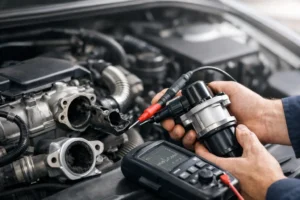
A warning light is rarely the full diagnosis. On a modern diesel, the same engine management light can be caused by a tired NOx sensor, an AdBlue pressure problem, a DPF that cannot complete regeneration, an EGR fault or a wiring issue. Mobile car diagnostics bring the proper testing equipment to the vehicle, so the fault can be investigated where the car or van is parked rather than guessed at from a dashboard message.
For drivers who rely on a diesel van for work, or need their car for commuting, that matters. A garage may quote for the part most commonly associated with a code. Proper diagnosis asks the more useful question first: why has that code appeared?
What mobile car diagnostics actually involve
A proper diagnostic visit is more than plugging in a basic code reader, clearing a light and hoping it stays off. The vehicle’s control units are scanned for stored, pending and historic fault codes. Live data is then checked to see what the relevant sensors and systems are doing while the engine is running.
For a diesel emissions fault, this may include DPF soot loading, differential pressure, exhaust gas temperatures, EGR commanded and actual position, AdBlue tank level, pump pressure, NOx sensor readings, SCR efficiency and battery voltage. The results need interpreting in context. A DPF pressure reading that looks high at idle, for example, can point to a blocked filter, but it can also be caused by split pressure hoses or a faulty differential pressure sensor.
The technician should also look at freeze-frame data. This records conditions when the fault was logged, such as engine temperature, road speed and mileage. It can show whether a code appeared on a cold start, during a regeneration attempt or under load. That evidence often separates the actual fault from the component blamed by the code description.
Why a fault code is not a parts list
Fault-code wording can be misleading. A code referring to “NOx sensor signal” does not automatically prove the sensor has failed. The sensor may have a power supply, earth, connector, communication or exhaust-related problem. Equally, an SCR efficiency code can appear because the AdBlue system is not dosing correctly, the exhaust has contamination, or the readings from one sensor are implausible.
This is particularly common on European diesels from Volkswagen Group, BMW, Mercedes-Benz, Peugeot, Citroen, Ford, Vauxhall and Land Rover. The systems differ in design, but all rely on several components working together. Replacing one expensive part without checking the wider system can leave the warning light exactly where it started.
A useful diagnosis considers three things together: the stored codes, the live readings and the symptoms. If a vehicle has an AdBlue warning followed by a no-start countdown, the urgent issue may be restoring the system’s ability to confirm emissions control operation. But the underlying cause still needs identifying. Simply topping up the tank will not fix a failed pump, heater, injector, level sensor or NOx sensor.
Common diesel faults that can be diagnosed at home or work
Many warning-light and drivability faults can be assessed on a driveway, workplace car park or depot, provided there is safe access to the vehicle. This is especially useful when reduced-power mode, a non-start countdown or an intermittent warning makes a trip to a garage inconvenient.
DPF faults and failed regeneration
The DPF stores soot produced during normal diesel running, then burns it off during regeneration when the conditions are right. Short journeys, interrupted regenerations, poor thermostat performance, failed temperature sensors, boost leaks and EGR faults can all prevent that process from completing.
Diagnostic testing checks whether the filter is genuinely restricted and whether the engine is capable of regenerating it safely. Soot load, ash accumulation, pressure readings and exhaust temperatures all matter. A forced regeneration is not a cure for every DPF warning. If the filter is heavily loaded, or the reason for failed regeneration has not been corrected, forcing the process can be ineffective and may create further problems.
AdBlue, SCR and NOx sensor problems
AdBlue is injected into the exhaust to reduce nitrogen oxide emissions through the SCR catalyst. A fault in this system may trigger an engine warning, an AdBlue warning or a message stating that the engine will not restart in a set number of miles.
The cause might be crystallisation around the injector, a weak supply pump, a tank heater fault, poor wiring, a contaminated system or a failed NOx sensor. Some faults only appear once the engine and exhaust are hot. This is why live data and manufacturer-level diagnostic information are more valuable than a generic scan alone.
EGR faults and reduced performance
The EGR system controls a measured amount of exhaust gas returning to the intake. When an EGR valve sticks, its position sensor gives an implausible reading, or the intake system is restricted by carbon deposits, symptoms can include hesitation, uneven idle, smoke, poor acceleration and limp mode.
An EGR-related code may also be the result of an air-flow discrepancy, boost issue or wiring fault. Testing commanded versus actual EGR operation, airflow readings and related codes helps avoid fitting a valve simply because it is named on a scan report.
When a mobile visit is the right option
Mobile diagnosis is a practical first step for most electronic engine and emissions faults. It saves arranging transport, taking time off work and driving a vehicle that may be in limp mode. It is also useful when the vehicle starts and runs but cannot be left at a garage for days while the cause is investigated.
There are limits. Some repairs need a ramp, specialist cleaning equipment, exhaust removal, component programming or extended road testing. A sound diagnostic process should be honest about that. The value of a mobile assessment is that it identifies the likely cause, confirms what can be repaired on site and gives a clear next step if workshop work is genuinely required.
For example, a faulty NOx sensor may be accessible and replaceable at the vehicle, while a DPF that is physically damaged or full of ash may need off-car cleaning or replacement. The correct route depends on the readings, the vehicle’s condition and the reason the fault developed.
What to do before the diagnostic appointment
Do not repeatedly clear the warning light. Clearing codes can remove useful freeze-frame data and may make an intermittent fault harder to trace. If possible, take a photograph of every dashboard message, including any mileage countdown, and note when the fault first appeared.
Bring together any recent repair history as well. A problem that started after a new battery, sensor replacement, DPF clean, AdBlue top-up or engine work may have a relevant connection. Be clear about the symptoms: whether the car loses power, starts poorly, uses more fuel, smells strongly of exhaust or only displays the warning after longer journeys.
It also helps to leave enough fuel in the tank and make sure the battery is reasonably charged. Low system voltage can create misleading communication and sensor codes, particularly after periods of short journeys or when a van has been standing.
Diagnosis first usually costs less
The temptation with diesel emissions faults is understandable: search the code, buy the part, fit it and hope. That approach can work occasionally, but it is expensive when the code is only reporting the effect of another failure. It is how owners end up paying for a new DPF, EGR valve or AdBlue component without curing the original warning.
A proper diagnostic assessment gives you evidence before authorising repairs. You should know what the fault means in plain English, what tests support the conclusion, whether the vehicle is safe to drive and what the realistic repair options are. That is a better position than accepting a vague recommendation to replace several parts.
Tech Tuning Northwest provides mobile diesel diagnostics across Greater Manchester for owners dealing with DPF, AdBlue, SCR, NOx sensor, EGR and ECU-related faults. The focus is on finding the cause before recommending the repair, with a straightforward explanation of what the vehicle is reporting and what needs doing next.
If a warning light has appeared once, treat it as useful evidence rather than an annoyance. Getting it checked while the vehicle still drives normally is often simpler, cheaper and far less disruptive than waiting for reduced power or a no-start countdown.