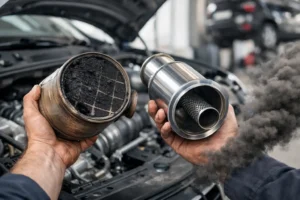
A diesel that feels flat below 2,000rpm, smokes more than usual or regularly brings on the engine management light may have an EGR issue. Knowing how to check EGR valve operation can stop you paying for an expensive part that is not actually at fault. EGR faults are common on modern diesel cars and vans, but the valve itself is only one part of a wider control system.
The sensible approach is to start with fault codes and live data, then check the physical components. Guessing from symptoms alone often leads to unnecessary EGR valve replacements.
What the EGR valve does on a diesel
EGR stands for exhaust gas recirculation. The system feeds a controlled amount of exhaust gas back into the inlet side of the engine, mainly at light to moderate load. This lowers combustion temperatures and reduces the production of nitrogen oxides, or NOx.
On many Euro 5 and Euro 6 diesels, the EGR valve works alongside an EGR cooler, intake throttle valve, DPF and SCR or AdBlue system. They are separate systems, but one fault can affect how another behaves. For example, an EGR valve stuck open can increase soot output and make DPF regeneration harder to complete.
The valve needs to open and close at the right time. If it is clogged with carbon, its electric motor is weak, its position sensor is inaccurate, or there is a wiring or vacuum fault, the ECU may detect that commanded movement does not match actual movement.
Common signs of an EGR valve fault
An EGR problem does not always produce a single obvious symptom. A valve stuck open tends to cause rough running, hesitation, poor low-speed response, excessive smoke and sometimes stalling when coming to a stop. This happens because too much exhaust gas is entering the inlet when the engine needs clean air.
A valve stuck closed may be less noticeable to the driver. The engine can feel reasonably normal, but combustion temperatures and NOx emissions rise. On newer vehicles, the ECU can identify this through airflow readings, EGR position feedback and emissions-related sensor data, then switch on the engine management light.
You may also notice reduced power, poor fuel economy, frequent DPF regeneration, a restricted-performance message or a failed emissions test. On vans used for short local runs, carbon build-up is particularly common because the engine spends too little time fully hot under a sustained load.
These symptoms can overlap with a blocked DPF, split boost hose, faulty MAF sensor, intake throttle fault or turbo control issue. That is why a code reader is useful, but it is not the whole diagnosis.
How to check EGR valve faults properly
Start by reading the fault codes
Use a diagnostic scanner capable of reading manufacturer-specific engine codes, not just a basic generic reader if possible. Generic codes such as P0400, P0401 and P0402 give a useful direction: EGR flow malfunction, insufficient flow and excessive flow respectively. Other common codes can refer to EGR position, control circuit, cooler efficiency or implausible airflow.
Do not assume a code proves the valve has failed. P0401, for instance, can be caused by blocked EGR passages, a failed vacuum solenoid, a leaking vacuum pipe, a faulty MAF sensor, a jammed intake flap or a valve that is not moving far enough. The code tells you what the ECU has seen, not why it has happened.
Record all codes before clearing anything. Also look for DPF differential pressure, intake air, boost-pressure, MAF and NOx-related faults. Multiple faults may point to one underlying issue, such as wiring damage or an air leak.
Check live data with the engine warm
With the engine at operating temperature, view the requested EGR position or flow and compare it with the actual position, where the vehicle provides both readings. At idle and during a controlled increase in engine speed, the figures should respond sensibly to ECU commands.
The exact numbers vary widely between manufacturers and engines, so there is no universal percentage that proves a valve is good. What matters is whether actual position follows requested position without sticking, lagging or remaining fixed at one value. A specialist diagnostic tool may also let you run an actuator test, commanding the valve open and closed while monitoring its feedback.
On some diesels, temporarily commanding EGR movement affects MAF readings. If the ECU requests EGR flow but the expected airflow change never happens, it may indicate a blocked valve, blocked cooler or passage, or a measurement problem with the MAF sensor.
Inspect the electrical connector and wiring
Many modern EGR valves are electronically controlled and include a built-in position sensor. With the ignition off, inspect the plug for oil, moisture, corrosion, loose terminals or damaged locking tabs. Follow the wiring loom as far as practical, especially where it passes near hot exhaust components or sharp brackets.
Avoid pushing test probes into terminals unless you know how to back-probe them correctly. Damaging a terminal can create an intermittent fault that is harder to diagnose than the original problem. A multimeter can check power supplies, earths and continuity, but expected values depend on the vehicle wiring diagram.
Older or simpler systems may use vacuum operation. Check the small vacuum pipes for splits, loose connections and oil contamination, and inspect the control solenoid. A hand vacuum pump can test whether a vacuum-operated actuator holds vacuum and moves, but it must be used according to the engine layout and specification.
Look for carbon build-up, but do not force the valve
Access varies greatly. On some engines the EGR valve is reasonably accessible at the front or top of the engine; on others it is buried behind pipework, the inlet manifold or the engine. Let the engine cool completely before inspecting anything around the exhaust side.
Once removed, a faulty EGR valve may show heavy dry soot, sticky carbon deposits, a seized spindle or a blocked gas passage. The EGR cooler and inlet manifold can also restrict with carbon, so cleaning the valve alone may not solve a flow-related code.
Do not lever an electronic valve open, soak its motor or sensor housing in cleaner, or scrape sealing faces aggressively. Some valves can be cleaned successfully when the fault is contamination, but cleaning will not repair a worn gear set, failed position sensor, burned wiring or failed actuator motor. Fit new gaskets where required and follow the correct relearn or adaptation procedure after refitting.
Why EGR faults are often misdiagnosed
A common mistake is replacing the EGR valve because the engine management light is on and an EGR-related code is stored. The valve may be the victim rather than the cause.
A DPF that is overloaded with soot can increase back-pressure and contribute to EGR-related faults. An intake leak can make airflow readings appear wrong. A faulty MAF sensor may cause the ECU to calculate EGR flow incorrectly. On certain Volkswagen Group, BMW, Mercedes-Benz, Ford, Vauxhall and Peugeot/Citroen diesel engines, restricted intake systems and EGR coolers are just as relevant as the valve itself.
Software updates and learned values can matter too. If a fault returns immediately after a replacement valve has been fitted, the issue may be wiring, incorrect adaptation, another airflow fault or a part that is not correctly matched to the vehicle. Pattern parts are not always a false economy, but an incorrectly specified or poor-quality unit can create more work.
When a professional diagnostic check makes sense
Basic visual checks and reading codes are realistic for a capable owner. Removing an EGR valve, interpreting live data and proving wiring faults are often better left to someone with the right scan equipment and experience of the engine in front of them.
This is especially true where the vehicle has EGR, DPF, AdBlue or NOx sensor faults together, is in reduced power, or is a working van that cannot be off the road for repeated trial-and-error repairs. A proper diagnostic session should establish whether the fault is mechanical, electrical, air-flow related or caused by another emissions component before parts are authorised.
Tech Tuning Northwest carries out diesel diagnostics for drivers across Greater Manchester, including mobile visits where suitable. The aim is to identify the cause of the fault first, explain the practical repair options clearly, and avoid replacing components on assumption.
If your diesel is still driving, do not ignore a recurring EGR code or warning light for months. Catching carbon build-up, an air leak or a control fault early can be far less disruptive than waiting for it to trigger DPF problems and reduced performance at the worst possible time.