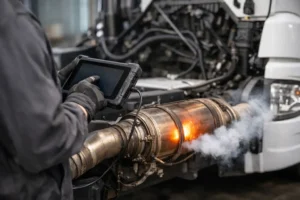
A DPF warning light is rarely caused by one short journey alone. It is usually the result of soot building up over time while the car has been unable to complete a proper regeneration. Knowing how to stop DPF clogging means understanding what your diesel particulate filter needs to do its job, and spotting the signs before a simple regeneration turns into a costly repair.
The good news is that many DPF problems can be prevented. The important part is not blindly taking the car for a fast drive every time a warning appears. If there is an underlying engine, sensor or emissions-system fault, that approach may not work at all.
What causes a DPF to clog?
The diesel particulate filter sits in the exhaust and captures soot produced during combustion. This reduces harmful particulate emissions, but the trapped soot must be burned away regularly in a process called regeneration.
On most modern diesels, the engine management system starts an active regeneration when it calculates that the soot level is high enough. It raises exhaust temperatures by adjusting fuelling and other engine settings, allowing the soot in the filter to burn away. A passive regeneration can also happen during sustained driving, when exhaust temperatures are naturally high enough.
Problems begin when regeneration is interrupted too often or cannot start. Short, low-speed trips are a common contributor, particularly with diesels used for school runs, local errands or stop-start commuting. The engine may not get fully warm, and the exhaust may not stay hot for long enough to clear the filter.
However, driving style is only part of the story. A DPF can clog because of a faulty differential pressure sensor, exhaust temperature sensor, NOx sensor, EGR valve, boost leak, injector issue or thermostat that is preventing the engine reaching operating temperature. On AdBlue-equipped vehicles, an SCR fault can also sit alongside DPF issues. The fault code matters because it tells you whether the filter is the problem or simply where the problem has become visible.
How to stop DPF clogging before the warning light appears
The best prevention is giving the vehicle regular opportunities to regenerate properly. For a diesel that mainly does local work, plan an uninterrupted run every week or two where practical. Once the engine is warm, a steady 20 to 30 minutes at A-road or motorway speeds is more useful than hard acceleration or sitting at high revs while parked.
There is no magic speed or rev figure that suits every vehicle. As a general guide, keep the engine working comfortably rather than labouring in a high gear. The aim is sustained exhaust heat, not driving aggressively. A van carrying tools or a loaded vehicle may need a different gear and road speed from an empty family car.
Do not switch the engine off halfway through an active regeneration if you can avoid it. Signs can include a slightly raised idle speed, cooling fans running after a journey, a hot smell from the exhaust area, temporarily poorer fuel economy or a stop-start system that is unavailable. These signs vary between manufacturers, so they are not a diagnosis on their own, but repeated interrupted regenerations will add to the soot load.
Using the correct low-SAPS engine oil is equally important. Low-SAPS oil is designed to produce less ash, which cannot be burnt out of the DPF. Soot can be removed through regeneration; ash stays in the filter and slowly reduces its capacity over the life of the vehicle. The wrong oil, overfilling the engine or stretching oil-change intervals can make matters worse.
Keep up with the manufacturer service schedule, especially air filters, fuel filters and oil changes. A restricted air filter or poor combustion can increase soot production, while neglected oil can become diluted with diesel if regenerations repeatedly fail. If the oil level rises above maximum or smells strongly of fuel, have the vehicle checked promptly rather than continuing to drive it.
Do not ignore the early symptoms
A DPF warning light is the obvious sign, but it is not the only one. Many drivers first notice reduced fuel economy, a sluggish response, frequent cooling-fan operation or a vehicle that appears to be regenerating far more often than it used to. On some models, an engine management light appears first, followed by restricted performance if the soot load continues to rise.
Once the car enters limp mode, the situation is more serious. The ECU may limit power to protect the engine and exhaust system, and a normal road regeneration may no longer be possible. Continuing to use the vehicle for short journeys can push the soot level beyond the point where a forced regeneration is safe.
A message such as “DPF full”, “risk of filter blocking” or “drive to clean exhaust filter” should be taken seriously, but the right response depends on the message and any stored fault codes. A warning asking for a drive may clear after a suitable run if there are no other faults. A flashing engine light, severe loss of power, excessive smoke or a high oil level needs diagnosis instead of guesswork.
Why a motorway run does not always fix it
The advice to “take it on the motorway” is sometimes right, but often incomplete. A motorway run cannot repair a failed pressure sensor, a stuck EGR valve or an exhaust temperature sensor giving implausible readings. The ECU relies on these inputs to decide when regeneration can happen and to monitor it safely.
It also cannot remove ash. A high-mileage DPF may have relatively low soot but be heavily ash-loaded, leaving little space for normal soot accumulation. This is one reason a vehicle can seem to regenerate regularly yet still block again soon afterwards. In that case, professional off-car cleaning may be a better option than repeated forced regenerations, depending on the filter condition.
Additives sold for the fuel tank can help in limited circumstances, but they are not a cure for a blocked or damaged DPF. They cannot fix sensor faults, excessive soot production or an ash-filled filter. Treat them as a maintenance aid at most, not an answer to a dashboard warning.
The faults that make DPF blockage return
If your DPF has been cleaned or regenerated and the warning returns quickly, the cause needs investigating. Common repeat offenders include EGR faults that alter airflow and increase soot, leaking intercooler pipes, split boost hoses, worn injectors, failing glow plugs, thermostat faults and incorrect sensor readings.
The differential pressure sensor and its pipes deserve particular attention. This system measures the pressure difference across the DPF so the ECU can estimate how restricted it is. A blocked, split or contaminated sensor pipe can make a healthy filter appear blocked, or allow a genuinely blocked filter to be missed until the problem is severe.
For vehicles with SCR and AdBlue systems, do not assume an AdBlue fault is unrelated. Modern diesel emissions systems share sensor data and operating conditions. A proper diagnostic session checks live data, fault codes, calculated soot and ash values, exhaust temperatures, pressure readings and whether regeneration has recently been attempted or aborted.
Deleting the DPF is not a sensible repair route. It is illegal for road use, can cause an MOT failure and often creates further ECU and emissions problems. The aim should be to restore the system so the vehicle runs correctly and remains compliant.
When to book a proper DPF diagnosis
If the warning light stays on after a suitable drive, returns repeatedly, or comes with reduced power, do not keep trying longer and faster journeys. The safest next step is a diagnostic check to establish the soot loading and identify why regeneration is failing. A forced regeneration without checking live data first can be risky on a heavily loaded filter or a vehicle with an unresolved fault.
For drivers who rely on a diesel car or van for work, early diagnosis is usually cheaper than waiting for limp mode, recovery costs or a replacement DPF quote. Tech Tuning Northwest provides mobile diesel diagnostics across Greater Manchester, checking the cause of the fault before recommending regeneration, cleaning or repair.
A DPF is not designed to be a constant worry. Give it the right operating conditions, use the correct oil, and act on the first unusual warning or change in behaviour. When the fault is diagnosed early, most cases are far more straightforward to resolve.