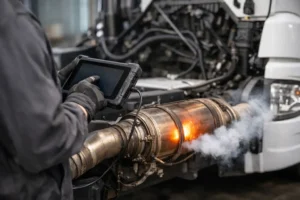
You are driving as normal, then the DPF light appears on the dash and the car may start to feel a bit flat. That usually leads to the same question: what causes DPF warning light problems in the first place? In most cases, the light comes on because the diesel particulate filter is filling with soot faster than the vehicle can burn it off, but the reason behind that can be simple, mechanical, or electronic.
A DPF is fitted to catch soot from the exhaust before it leaves the vehicle. When everything is working properly, the system carries out a regeneration. That means it raises exhaust temperature and burns the soot into a smaller amount of ash. The problem starts when that regeneration either cannot happen, keeps getting interrupted, or another fault in the engine or emissions system causes excess soot to build up.
What causes DPF warning light faults most often?
The most common cause is repeated short journeys. Diesel engines that are used for school runs, local errands, stop-start commuting or short van trips around town often do not get hot enough for long enough to complete a proper regeneration. The soot keeps collecting until the filter reaches a threshold and the warning light comes on.
That is the basic answer, but it is not the only one. A DPF warning light can also be triggered by a failed sensor, an EGR fault, a boost leak, injector issues, poor combustion, or a problem with the system that controls regeneration. Sometimes the filter itself is not the root cause at all. It is just where the symptoms end up.
This is where many owners get caught out. A garage may say the DPF is blocked and quote for replacement, when the real issue is the reason it blocked in the first place. If that underlying fault is missed, even a cleaned or replaced DPF can block again.
How the DPF warning light system works
The vehicle does not guess when the filter is full. It uses data. Pressure sensors measure the difference in exhaust pressure before and after the DPF. Temperature sensors help the ECU judge whether regeneration is possible and whether it has worked. The ECU also monitors driving conditions, soot loading calculations and, on some vehicles, related systems such as EGR and AdBlue.
If the readings show soot loading is too high, the ECU requests a regeneration. If that regeneration fails or the pressure reading remains too high, the DPF warning light is triggered. On some vehicles you will only see a single amber light. On others, you may also get an engine management light, glow plug light, limp mode, or a dashboard message telling you to continue driving.
Common reasons the DPF light comes on
Short journeys are still the biggest one, especially on modern diesel cars used like petrol cars. But there are several other regular causes we see across European diesel vehicles.
Interrupted or failed regeneration
A regeneration needs the right temperature and driving conditions. If the car is repeatedly switched off halfway through the process, soot loading rises. Some drivers do not even realise a regen is happening. They may notice the cooling fan running, the idle speed sitting slightly higher, or fuel economy dropping for a while, then turn the engine off as usual.
Faulty pressure or temperature sensors
A bad DPF pressure sensor can make the ECU think the filter is more blocked than it really is. Split pressure pipes can do the same. Faulty exhaust gas temperature sensors can prevent regeneration because the ECU no longer trusts the temperature data.
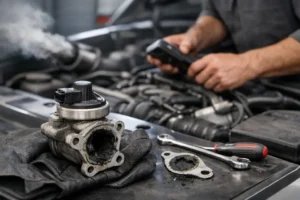
EGR valve problems
If the EGR valve sticks open or behaves incorrectly, combustion quality can suffer and soot production often increases. That extra soot heads straight to the DPF. In practice, EGR faults and DPF faults often arrive together.
Injector or combustion issues
Worn injectors, poor spray patterns, over-fuelling, boost leaks and air intake faults all affect how cleanly the engine burns diesel. When combustion is not right, soot output rises. The DPF then has to cope with more than it should.
Low-quality driving conditions for a diesel engine
This is slightly different from short journeys alone. Even if a vehicle covers a fair number of miles, slow average speeds, heavy traffic and frequent idling can all stop proper regeneration. A diesel used mainly in city conditions is always more at risk.
Existing ash build-up
Unlike soot, ash does not burn off during regeneration. It builds slowly over time from oil additives and normal use. On higher-mileage vehicles, the DPF can become restricted with ash even if regeneration is working as designed. At that point, a forced regen is not always the answer.
When the warning light means more than a simple blockage
Not every DPF warning is at the early stage. If you keep driving with the light on, the soot load can rise to the point where the vehicle limits power. That is when owners often describe the car as sluggish, stuck in limp mode, or unwilling to rev freely.
Leave it longer and the vehicle may log more serious fault codes. In some cases, active regeneration becomes impossible because the soot load is too high. There is also a risk of excessive exhaust temperatures, oil dilution from repeated failed regens, and damage to turbocharger or engine components if the problem is ignored for too long.
That is why timing matters. A DPF warning light dealt with early is often a much smaller job than one that has been left for weeks.
What should you do when the DPF light comes on?
It depends how the vehicle is behaving. If the DPF light is the only warning and the car is still driving normally, the manufacturer may be expecting you to complete a drive cycle that allows regeneration. That usually means a sustained run at proper road speed, with the engine fully warmed up, rather than another ten minutes through traffic.
But this only helps if the car is actually capable of regenerating. If there is an EGR fault, pressure sensor issue, glow plug problem, thermostat fault, injector problem or excessive soot loading, simply taking it for a run may do nothing at all.
If the engine management light is also on, if the car has gone into reduced power mode, or if the warning returns quickly after a longer drive, it needs diagnosing properly. Guesswork gets expensive with DPF systems.
Proper diagnosis matters more than clearing the light
A lot of people have already been told to try fuel additives, take it on the motorway, or have a forced regeneration carried out. Sometimes that works. Quite often it does not, because the real cause has not been dealt with.
A proper diagnostic process looks at soot load, ash load where available, differential pressure readings, temperature sensor behaviour, fault codes, regeneration history and any related issues in the intake, fuel or EGR system. That gives a much clearer picture of whether the filter is genuinely blocked, whether a sensor is lying, or whether another fault is overloading the DPF.
This is also where experience counts. Different makes have different weak points. Some are known for split pressure pipes. Some suffer with failed EGR coolers, thermostat issues or injector problems. Others trigger repeated DPF faults because the software strategy is sensitive to interrupted use. The dash light may look the same, but the fix is not always the same.
Can you keep driving with the DPF warning light on?
Sometimes, briefly, yes. Sensibly, not for long. If the light has only just appeared and the vehicle is otherwise normal, you may have a small window to allow a regeneration or get it inspected before it gets worse.
If there is a loss of power, multiple warning lights, smoke, a strong hot smell, frequent cooling fan activity, or rising oil level, stop putting it off. Those signs suggest the issue may already be beyond a simple passive fix.
For vans and work vehicles this matters even more. Waiting until the vehicle forces itself into limp mode usually means more disruption, not less.
The repair depends on the real cause
There is no honest one-size-fits-all answer here. Some vehicles need nothing more than a successful regeneration after confirming the system is healthy. Others need sensor replacement, EGR repair, injector checks, intake leak repairs or professional DPF cleaning. In severe cases, where the filter is damaged or overloaded beyond recovery, replacement may be the only sensible route.
The key point is that the DPF warning light is a symptom, not a final diagnosis. Treating the light without finding the cause is how owners end up paying twice.
At Tech Tuning Northwest, a lot of the diesel fault work we see starts this way – one warning light, a bit of lost performance, and plenty of poor advice beforehand. The best outcomes usually come when the fault is checked early, the data is read properly, and the root cause is fixed before the DPF becomes a much bigger expense.
If your DPF light has come on, the most useful thing you can do is act while the vehicle is still giving you options.