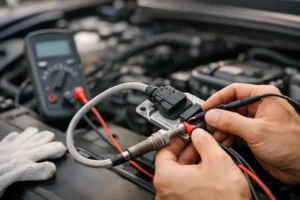
A diesel that suddenly feels flat, will not pull properly uphill or refuses to rev beyond a certain point is usually protecting itself. That reduced-power setting is commonly called limp mode. Knowing how to diagnose diesel limp mode properly can prevent a costly cycle of replacing parts that were never faulty in the first place.
Limp mode is not a fault in its own right. It is the ECU’s response to a fault it considers serious enough to limit engine power, protect the emissions system or prevent damage. On many cars and vans, switching the ignition off and back on may restore normal power temporarily. That does not mean the problem has gone away. It means the ECU has reset the protection strategy until it sees the fault condition again.
What diesel limp mode feels like
The symptoms vary by vehicle, but the pattern is usually clear. Acceleration becomes noticeably weaker, overtaking is difficult and a loaded van may struggle on hills. Some vehicles limit revs, while others still rev but have very little turbo boost. You may also see an engine management light, glow plug warning light, DPF warning, AdBlue warning or a message such as “Engine fault: repair needed”.
A temporary loss of power under hard acceleration is particularly common with turbo control faults. A vehicle that stays in reduced power after a warning about emissions, exhaust fluid or a non-start countdown may have an AdBlue or SCR-related issue. If the DPF warning has been ignored for weeks, the car may limit power because soot loading has risen too far for a normal regeneration.
Do not assume every warning light points to the component named on the dashboard. A DPF message can be caused by a pressure sensor, split hose, failed temperature sensor or an underlying EGR and boost fault that is creating too much soot.
How to diagnose diesel limp mode step by step
The right diagnosis starts by confirming the circumstances, not by fitting a new sensor. A good technician will ask when the fault happens: only under acceleration, after a motorway run, when cold, after refuelling, or all the time. That history often narrows the search quickly.
Read fault codes with suitable diagnostic equipment
The first practical step is a full diagnostic scan. A basic code reader can be useful, but many cheap readers only show generic engine codes and miss manufacturer-specific information. Proper equipment can read stored, pending and historic codes from the engine ECU and, where relevant, the AdBlue, transmission and body control modules.
Fault codes are clues, not a repair instruction. For example, a turbo underboost code may relate to a leaking boost pipe, seized actuator, vacuum problem, sticking variable vanes, faulty boost pressure sensor or an actual turbocharger failure. Replacing the turbo without checking the rest is an expensive gamble.
Freeze-frame data matters as well. It records the engine speed, load, temperature and other conditions when the code was set. A fault that occurs at 2,800 rpm under high load needs investigating differently from one that appears at idle on a cold start.
Check live data against what the engine is doing
Live data is where diagnosis moves beyond guesswork. The technician compares what the ECU is requesting with what the system is actually delivering. Depending on the vehicle and fault codes, this may include requested and actual boost pressure, mass air flow, EGR position, DPF differential pressure, exhaust temperatures, soot calculated by the ECU and AdBlue system readings.
On a boost fault, the key question is whether actual boost follows the requested value during a controlled road test. On a DPF fault, differential pressure should be assessed at suitable engine speeds alongside calculated soot load and regeneration history. A high pressure reading may indicate a restricted filter, but it can also be caused by blocked or damaged pressure pipes.
This is why a quick scan in a car park is not always enough. Some faults only show themselves when the engine is under load. A safe, monitored road test can reveal the point at which the ECU sees a value outside its permitted range and triggers limp mode.
Inspect the simple physical causes
Before condemning major components, the intake, vacuum and exhaust-related pipework should be checked closely. Split intercooler hoses, loose clips and oil-contaminated boost pipes are common on many European diesels. A small leak can be quiet at idle but open under boost pressure, leaving the vehicle sluggish and logging an underboost fault.
Vacuum-operated turbo systems need their hoses, solenoids and actuator movement checked. Electronic actuators can suffer wiring, connector or internal position-sensor faults. On older or hard-worked vans, wiring damage and corroded connectors deserve proper attention, especially around sensors exposed to heat and road spray.
The exhaust side also needs inspection. A cracked pressure hose, leaking exhaust joint before a sensor or damaged wiring can produce readings that make a healthy component look faulty to the ECU.
Common causes of limp mode on diesel cars and vans
DPF restriction and failed regeneration
A DPF collects soot from the exhaust and burns it off during regeneration when operating conditions allow. Repeated short journeys, interrupted regenerations, sensor faults and other engine problems can stop that process working properly. As soot loading rises, the ECU may restrict power to protect the filter and exhaust system.
A forced regeneration is not automatically the answer. It should only be considered after checking soot load, ash load, pressure readings, fault codes, oil level and the reason regeneration failed. Forcing a regeneration on a severely restricted DPF or a vehicle with a fuelling, temperature or boost fault can cause further problems. In some cases, professional off-car cleaning or a replacement DPF is the sensible route. In others, fixing the sensor or underlying fault restores normal regeneration.
Turbo boost and air-intake faults
Turbo-related limp mode is common across Volkswagen Group, BMW, Mercedes-Benz, Ford, Peugeot, Citroën, Renault and Vauxhall diesels, among others. The ECU expects a certain level of air pressure. Too little boost can mean a leak or control issue; too much boost can point to a sticking turbo mechanism or actuator problem. Either condition can trigger protective reduced power.
The trade-off is clear: a turbocharger may genuinely be worn or damaged, but it should be the conclusion after checks, not the starting point. Testing the actuator, air path and sensor readings first can save a substantial bill.
EGR valve faults
The EGR system recirculates a controlled amount of exhaust gas to reduce emissions. Carbon build-up can cause the valve to stick open or closed, while position sensors and coolers can also fail. A stuck EGR valve can create poor response, smoke, uneven running and excessive soot production, which can then contribute to DPF trouble.
An EGR code does not always mean the valve itself is beyond repair. The inlet system, wiring, sensor feedback and airflow readings must support the diagnosis. Some vehicles require cleaning; others need component replacement, depending on the fault and condition.
AdBlue, SCR and NOx sensor faults
Modern Euro 6 diesels use AdBlue and an SCR catalyst to reduce nitrogen oxide emissions. Faults in this system can bring up an emissions warning, reduced power or a countdown stating that the engine will not restart after a certain mileage. Common causes include failed NOx sensors, crystallised AdBlue around the injector, tank heater faults, pump pressure faults, wiring issues and software-related faults.
These systems are often misdiagnosed because the code may identify the part of the system where the ECU noticed the problem, rather than the original cause. A proper assessment checks fault-code status, tank level, dosing behaviour, pressure where available, wiring integrity and relevant live values. Clearing the message without resolving the fault usually only delays the next warning or the no-start condition.
Avoid these costly shortcuts
Clearing codes repeatedly is useful only as part of testing after a repair. It is not a fix. Likewise, replacing the DPF pressure sensor, EGR valve, NOx sensor or turbo based solely on one code can be money wasted.
Be cautious with any repair recommendation that does not include an explanation of the evidence. You should be told what fault codes were present, what the live data showed and why the proposed repair addresses the cause. For a working vehicle, that clarity matters as much as getting the warning light turned off.
If limp mode appears while driving, avoid hard acceleration, heavy towing and long journeys until the cause is known. If there is excessive smoke, a flashing warning light, overheating, a strong exhaust smell in the cabin or abnormal mechanical noise, stop using the vehicle and arrange professional help.
When specialist diesel diagnosis is worthwhile
A specialist is especially worthwhile when the vehicle has returned from another garage with the same fault, several warnings are present at once, or an expensive component has been recommended without clear test results. Diesel emissions systems interact closely: an air leak can affect DPF loading, an EGR fault can increase soot, and an SCR fault can create its own set of restrictions and warnings.
For drivers in Greater Manchester who need a practical answer without leaving a van off the road at a garage, Tech Tuning Northwest provides mobile diesel diagnostics focused on finding the actual fault before recommending a repair. The aim should always be a fix that makes technical and financial sense, not a list of speculative parts.
A limp-mode warning is frustrating, particularly when the vehicle is needed for work the next morning. Treat it as useful information from the ECU, get the evidence behind it checked properly, and you are far more likely to pay once for the right repair.