Limp mode usually appears at the worst possible time: joining the motorway, climbing a hill with tools in the van, or halfway through a working day. The question of how to clear limp mode has a simple answer, but it is not always the answer drivers want to hear. You can often clear the warning temporarily, but unless the underlying fault is fixed, the engine ECU is likely to put the vehicle straight back into reduced-power mode.
On a modern diesel, limp mode is not a fault in itself. It is the ECU protecting the engine, turbocharger or emissions system after it has detected a reading outside its safe operating range. Treating it as a warning to investigate, rather than an inconvenience to erase, can prevent a small sensor issue becoming a much larger repair bill.
What limp mode actually does
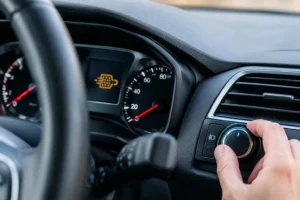
Limp mode is also called reduced power, engine management protection mode or emergency running mode. The exact dashboard message differs between manufacturers, but common examples include “Engine fault: repair needed”, “Reduced engine power”, “AdBlue system fault” and an illuminated engine management light.
The ECU limits power by restricting fuel delivery, turbo boost or engine speed. On some vehicles, the car will still drive reasonably around town but feel flat under acceleration. Others will struggle to go beyond a certain speed, often making motorway driving unpleasant or unsafe.
Diesel cars and vans from Volkswagen Group, BMW, Mercedes-Benz, Ford, Peugeot, Citroen, Renault, Vauxhall and Land Rover can all enter limp mode for different reasons. The protection strategy is broadly the same, but the cause and the correct repair are not.
How to clear limp mode safely
If there is no red warning light, no overheating, no smoke and no major mechanical noise, pull over safely and switch the engine off. Leave it for a few minutes, then restart it. Some intermittent faults reset after an ignition cycle, particularly a one-off boost pressure reading or an emissions value that briefly fell outside tolerance.
If full power returns, do not assume the problem has gone away. The ECU will usually retain a fault code, either as current, stored or pending. That code, along with the live data recorded by a diagnostic tool, gives the clearest clue about why limp mode was triggered.
The proper way to clear limp mode is to diagnose and repair the fault, then erase the confirmed fault code using suitable diagnostic equipment. A basic code reader may switch off the engine management light, but it cannot repair a split boost hose, a blocked DPF, a faulty NOx sensor or an AdBlue pressure problem. If the ECU sees the same issue again, limp mode will return.
Disconnecting the battery is not a reliable fix either. It may reset some learned values on older vehicles, but modern ECUs often retain faults in non-volatile memory. It can also create unnecessary issues with electric windows, radio codes, steering angle sensors and battery monitoring systems.
If limp mode has appeared alongside an AdBlue no-start countdown, clearing a generic code is especially unlikely to solve it. The SCR system must pass its own checks before the countdown can be removed. The fault needs identifying first.
Do not force a DPF regeneration while the cause is unknown
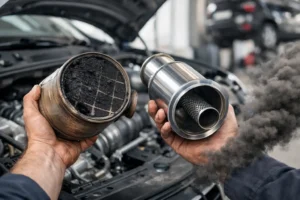
A forced regeneration is sometimes appropriate, but only after checking why the DPF soot loading has risen. If the filter is overloaded because of a failed pressure sensor, EGR issue, boost fault, injector problem or unsuccessful passive regenerations, forcing heat into the system can be counterproductive.
A proper diagnostic assessment looks at calculated soot load, ash accumulation, differential pressure, exhaust temperature sensors and the conditions preventing regeneration. There is a difference between a DPF that needs a supported regeneration and one that needs cleaning, component repair or further engine diagnosis.
The faults most likely to cause diesel limp mode
Turbo and boost-control faults are a very common cause. A split intercooler hose, sticking turbo actuator, vacuum leak, faulty boost pressure sensor or variable-vane turbo issue can cause either overboost or underboost. The ECU sees that requested boost and actual boost do not agree, then limits power to protect the engine.
DPF faults are another regular trigger. Short journeys, interrupted regenerations and underlying engine faults can allow soot to build up until the ECU restricts performance. A DPF warning light may come first, but some vehicles move into limp mode once calculated loading reaches a critical level.
AdBlue and SCR faults can also reduce performance, although many systems initially issue a warning and a mileage countdown rather than immediate limp mode. Failed NOx sensors, crystallised AdBlue injectors, poor tank pressure, heater faults and wiring damage are all seen regularly on Euro 6 diesels. Replacing parts on guesswork is expensive, particularly where a sensor fault is actually caused by wiring, contamination or an SCR efficiency issue.
EGR valve faults matter too. If the valve sticks open, the engine may feel sluggish, smoky or uneven. If it sticks closed, emissions values can rise and trigger related faults. Carbon build-up is common, but it is not the only explanation: position sensors, actuators, wiring and air leaks must be considered.
Fuel pressure faults, air mass meter readings, intake flap problems and exhaust temperature sensor faults can produce similar reduced-power symptoms. This is why the message on the dashboard alone cannot confirm the repair required.
Why clearing the code can make diagnosis harder
Clearing fault codes before recording them removes useful evidence. Many ECUs store freeze-frame data showing engine speed, temperature, boost pressure, mileage and other readings at the point the fault occurred. That information can separate a genuine turbo control issue from a sensor that only fails once the engine is hot.
It can also hide whether faults are linked. For example, a DPF pressure code may be the result of a blocked filter, but it could also be caused by a damaged sensor pipe or a faulty differential pressure sensor. Clearing the code and driving until it returns may provide a temporary reset, but it adds mileage and can push an already loaded DPF closer to the point where regeneration is no longer sensible.
A code is a starting point, not a parts list. “Boost pressure regulation” does not automatically mean the turbocharger needs replacing, and a NOx sensor code does not automatically mean a new sensor will cure the problem.
What a proper limp mode diagnosis should include
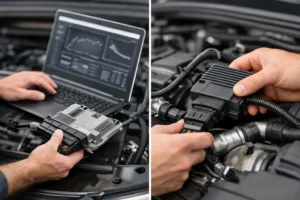
A worthwhile diagnosis starts with a full vehicle scan, not just the first code shown by a handheld reader. The technician should check fault status, freeze-frame information and manufacturer-specific codes across the engine, emissions and AdBlue control systems.
Live data then matters. Depending on the fault, this may include requested and actual boost, DPF differential pressure, soot load, exhaust gas temperatures, EGR command and position, NOx readings, AdBlue tank pressure and SCR efficiency. A visual inspection is equally important, as split hoses, damaged connectors, loose pressure pipes and signs of fluid crystallisation are often found without dismantling half the vehicle.
The final repair should follow the evidence. That may mean repairing a boost leak, replacing a failed sensor, cleaning a DPF professionally, resolving an EGR fault or carrying out a correctly supported regeneration once the system is safe to do so. After repair, fault codes are cleared and the relevant live values are checked again to confirm the ECU is no longer seeing the condition that caused limp mode.
When you should stop driving
Do not try to clear limp mode and carry on if there is a red engine or temperature warning, heavy smoke, a strong burning smell, severe misfire, unusual turbo noise or a significant loss of oil or coolant. Stop safely and arrange recovery where necessary. Continuing to drive can turn a repairable fault into turbo, engine or DPF damage.
If the vehicle is simply in reduced power with an amber warning light, keep driving to a minimum until it has been assessed. Avoid towing, heavy loads, hard acceleration and long high-speed runs in the hope that it will “blow itself clear”. That approach occasionally helps a lightly loaded DPF on the right journey, but it will not fix a failed component.
For drivers across Greater Manchester who need a diesel fault diagnosed at home or work, Tech Tuning Northwest can assess the codes and live data properly before recommending a repair. The aim is not to sell parts or erase warnings for a day – it is to find out why the ECU has stepped in and return the vehicle to reliable, normal operation.
The most useful reset is the one you do not have to repeat: fix the reason for limp mode, prove the readings are right, and let the vehicle earn back its full power.