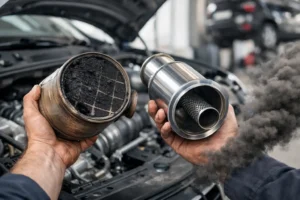
A DPF warning light is not usually a fault you fix by simply pressing a button. If you are searching for how to reset DPF light warnings, the honest answer is that the light should only be cleared after the filter has successfully regenerated or the underlying fault has been repaired. Clearing it too early can leave the DPF overloaded and turn a manageable issue into an expensive repair.
For many diesel drivers, especially those doing short trips around town, the first warning is the vehicle asking for a proper drive. In that situation, a successful regeneration may switch the light off by itself. But if the light stays on, the engine loses power, or other warnings appear, the car needs diagnosing rather than guesswork.
What the DPF light is actually telling you
The diesel particulate filter, or DPF, sits in the exhaust system and traps soot produced by the engine. It is designed to clean itself through regeneration: the exhaust temperature rises high enough to burn accumulated soot into a much smaller amount of ash.
A normal regeneration happens automatically when the vehicle is driven under suitable conditions. A regular run at a steady speed gives the engine and exhaust time to reach the temperatures needed. Problems start when a car or van mainly does short, slow journeys, school runs, stop-start commuting or local delivery work. The regeneration begins but cannot finish often enough, so soot builds up.
The DPF light is the vehicle’s early warning that the soot level has reached a point where it needs attention. It does not automatically mean the filter is ruined. Equally, it is not a warning to ignore for another few weeks.
Different makes use different symbols and messages. Volkswagen, Audi, SEAT and Skoda models commonly show a yellow DPF symbol. BMW, Mercedes-Benz, Peugeot, Citroen, Ford, Vauxhall, Land Rover and Nissan diesels may display a filter warning, an engine-management light or a message telling the driver to continue driving. The meaning depends on the warning combination and fault codes stored in the ECU.
How to reset DPF light warnings safely
If the DPF light has come on by itself and there is no flashing engine-management light, no reduced-power message and no obvious running fault, a controlled drive may be enough to allow an active regeneration.
Start with enough fuel in the tank, ideally above a quarter full. Get the engine properly warm, then drive on a clear dual carriageway or motorway for around 20 to 30 minutes at a steady speed. The exact revs vary by vehicle, but staying in a lower gear than usual, where safe and legal, can help keep engine speed and exhaust temperature up. Avoid repeatedly stopping, idling or switching off halfway through.
This is not about driving flat out. A steady, sensible journey is more useful than harsh acceleration. Once the regeneration is completed, some vehicles turn the light off during the drive; others may need an ignition cycle before the warning disappears.
If the warning clears and does not return, the filter has probably completed a regeneration. It is still worth changing the driving pattern where possible. A diesel used mostly for short journeys may need a longer run regularly to avoid the same issue returning.
Do not attempt a road regeneration if the vehicle is in limp mode, the DPF light is accompanied by a red warning, the engine-management light is flashing, or there is a message saying the filter is full. Continuing to drive in those circumstances can cause further problems.
Why a diagnostic scanner does not always fix it
A garage-level diagnostic tool can clear a DPF-related fault code, but clearing the code is not the same as cleaning the filter. The ECU monitors calculated soot load, pressure across the DPF, exhaust temperatures and the result of previous regeneration attempts. If the cause remains, the warning will often return quickly.
More importantly, some vehicles will not permit another regeneration while an active fault is present. A failed temperature sensor, faulty differential pressure sensor, split sensor hose, EGR fault, boost leak or injector issue can stop the regeneration process. On AdBlue-equipped diesels, SCR and NOx sensor faults can also sit alongside DPF faults, although they are separate systems.
A proper diagnostic check looks at live data, not just the wording of a generic code reader. That includes soot and ash readings, DPF pressure values at idle and under load, exhaust gas temperatures, coolant temperature, regeneration history and related engine fault codes. This identifies whether the DPF is genuinely blocked, whether a sensor is reporting nonsense, or whether the engine is creating too much soot in the first place.
When a forced regeneration is appropriate
A forced regeneration uses diagnostic equipment to command the vehicle to raise exhaust temperatures and burn off soot while stationary or during a controlled road procedure. It can be effective, but it is not the first answer for every DPF light.
The process generates extremely high exhaust temperatures. It must only be carried out after checks confirm there are no faults that could make it unsafe or ineffective. A filter with excessive soot loading may be beyond the safe limit for forced regeneration. Trying anyway risks overheating the DPF, damaging the exhaust system or, in severe cases, creating a fire risk.
It also cannot remove ash. Soot burns away during regeneration, while ash from oil additives and normal engine wear stays in the filter. Over time, ash capacity is used up and the DPF may require professional off-car cleaning or replacement. This is why a vehicle with high mileage can have repeated DPF problems even when it receives regular longer runs.
Signs the problem is more than a simple regeneration
Book proper diagnosis rather than trying to reset the warning at home if you notice any of the following:
- The DPF light returns soon after a long run.
- The car has reduced power or goes into limp mode.
- An engine-management, glow plug, AdBlue or emissions warning is also displayed.
- Fuel consumption has increased or the cooling fan runs after switching off.
- The oil level is rising or smells strongly of diesel.
- The vehicle has already failed or aborted several regeneration attempts.
An increasing oil level matters because repeated incomplete regenerations can allow diesel fuel into the engine oil on some vehicles. Driving with diluted oil risks accelerated engine wear. Do not assume a DPF reset will deal with that issue.
Common mistakes that make DPF faults worse
The biggest mistake is repeatedly clearing the fault code and carrying on. The warning may disappear temporarily, but the ECU still sees the soot loading and may eventually restrict performance to protect the engine and exhaust system.
DPF cleaning additives can sometimes help as part of the right repair, but they are not a guaranteed cure for a heavily blocked filter, a failed sensor or an engine fault. The same applies to taking the vehicle for a hard drive when it is already in limp mode. More heat is only helpful when the system is healthy enough to control regeneration correctly.
Removing or disabling a DPF is not a legitimate repair for a road vehicle. It can cause MOT and insurance issues, affect emissions compliance and leaves the underlying engine problem unresolved.
Getting the right repair for your diesel
The correct solution depends on what the diagnostic results show. A lightly loaded DPF with no related faults may only need a completed regeneration and a change in driving routine. A failed pressure sensor or temperature sensor needs replacing and verifying. If the DPF is genuinely restricted, professional cleaning may restore it. If an EGR, turbo, injector or air-intake fault is causing excess soot, that fault must be fixed before the filter can stay healthy.
For drivers in Greater Manchester who rely on a diesel car or working van, a mobile specialist diagnosis can save time and prevent unnecessary parts being fitted. Tech Tuning Northwest diagnoses the whole emissions system, checks live ECU data and explains what has failed before recommending a repair. That is usually far better value than approving a replacement DPF based on one dashboard warning.
Treat the DPF light as an early prompt, not a nuisance to erase. If a proper run clears it, give the vehicle the conditions it needs to regenerate. If it does not, getting the real cause identified early is the sensible way to protect both the filter and the engine.