A DPF warning light does not automatically mean the filter needs replacing. The key is understanding DPF soot versus ash. Both collect inside the diesel particulate filter, both can restrict exhaust flow, and both can trigger reduced power. But they behave very differently – and confusing one for the other is how drivers end up paying for the wrong repair.
Soot can normally be burnt away through regeneration. Ash cannot. A vehicle with a soot-loaded DPF may recover after the underlying fault is fixed and a proper regeneration is carried out. A DPF full of ash has reached a different stage: it needs professional cleaning or, in some cases, replacement.
DPF soot versus ash: the simple difference
A diesel particulate filter sits in the exhaust and catches fine carbon particles produced during combustion. This is soot. It is the black material most people associate with diesel exhaust.
When conditions are right, the engine management system raises exhaust temperatures and burns the soot away. This process is called DPF regeneration. Depending on the vehicle, it may happen passively during sustained driving or actively through additional fuel injection and changes to engine operation.
Ash is what remains after substances in the engine oil and fuel have been burned. Small amounts of oil additives, metallic compounds and other non-combustible residue eventually build up in the filter. Unlike soot, ash does not burn off during a regeneration, even if exhaust temperature becomes very high.
Put simply, soot is the temporary load the DPF is designed to manage. Ash is the permanent residue that slowly takes away the filter’s usable capacity over time.
Why the distinction affects the repair
A soot problem often has a cause that can be identified and corrected. Repeated short trips, interrupted regenerations, a faulty thermostat, split boost hose, EGR fault, injector issue, failed exhaust temperature sensor or inaccurate differential pressure sensor can all stop the DPF from regenerating properly.
If the filter is mainly loaded with soot, resolving the fault and carrying out a controlled regeneration may be enough. This is not the same as simply clearing a warning light. The diagnostic process must confirm that the vehicle can regenerate safely, that sensor readings are believable and that the soot level is not already beyond the manufacturer’s safety limit.
Ash is different. The vehicle may still complete regenerations successfully, but the gap between them becomes shorter because there is less free space inside the filter. Eventually, exhaust back pressure rises and the engine may log DPF efficiency or pressure-related faults. At that point, repeated forced regenerations will not remove the ash. They can add unnecessary heat stress without solving the restriction.
A quality off-car DPF clean can remove a significant amount of ash and restore flow where the filter structure is sound. It depends on the filter’s condition, the contamination present and whether another engine fault caused excessive soot in the first place. Cleaning a filter without dealing with the cause of the soot load is often a short-lived fix.
Symptoms of soot loading and ash loading
The warning signs can overlap, which is why guessing is risky. Common DPF-related symptoms include a DPF warning light, engine management light, limp mode, poor acceleration, increased fuel consumption, a cooling fan running after the ignition is switched off and an unusually high idle speed during regeneration.
With a soot-loaded DPF, symptoms may appear suddenly after weeks of short journeys, stop-start work or several interrupted regenerations. A van used for local deliveries may be particularly vulnerable, although motorway mileage does not guarantee immunity if there is a sensor or engine fault.
Ash loading is usually more gradual. The vehicle may seem to regenerate more often, fuel economy can worsen over time, and DPF pressure readings may remain higher than expected even after a successful regeneration. Higher-mileage diesel cars and vans are more likely to have an ash-capacity issue, but mileage alone does not prove it.
Many Volkswagen Group, BMW, Mercedes-Benz, Peugeot, Citroen, Ford and Vauxhall diesel models calculate soot and ash loads using a mixture of sensor data and stored values. These calculations are useful, but they are not a substitute for checking live readings, fault codes, service history and the actual exhaust pressure behaviour.
How a DPF knows when to regenerate
The ECU monitors several inputs before it decides to start an active regeneration. These commonly include calculated soot mass, differential pressure across the DPF, exhaust gas temperature, coolant temperature, fuel level and the status of related systems.
The differential pressure sensor deserves particular attention. It measures the pressure before and after the DPF. If the sensor fails, its pipes block with soot or condensate, or there is a leak in the pipework, the ECU can be misled into thinking the DPF is blocked when it is not. The opposite can also happen: a restricted filter can be missed until the problem becomes severe.
That is why a diagnostic check should go beyond reading one code. A fault such as P2002, P2463, P2452 or P2453 may point towards the DPF or its pressure sensor circuit, but the code is the starting point, not the final diagnosis.
Can a long drive clear the problem?
Sometimes, but only in the right circumstances. If the DPF light has just appeared, there are no other engine or emissions warnings, the vehicle is running normally and the handbook permits it, a sustained drive at steady speed may allow a normal regeneration to finish.
It will not remove ash. It will also not repair an EGR problem, failed temperature sensor, thermostat fault, injector issue or pressure sensor fault. Continuing to drive a vehicle that is already in limp mode or displaying multiple warnings can make matters worse, especially if fuel dilution is occurring from repeated failed regeneration attempts.
Avoid the common advice to keep driving until the light goes out at any cost. If the warning returns quickly, the engine management light is on, or the vehicle has reduced power, it needs proper diagnosis rather than another hopeful motorway run.
When cleaning is worthwhile
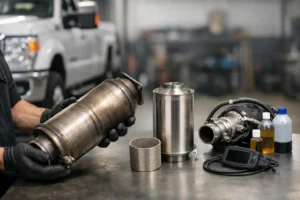
DPF cleaning is worthwhile when testing shows the filter is genuinely restricted and the core is intact. It is particularly useful for ash accumulation, where regeneration cannot help. The best method normally involves removing the DPF and cleaning it with equipment designed to flush contamination from the channels, followed by flow testing.
Chemical additives poured into the fuel tank are not the same as professional cleaning. They may assist a healthy vehicle in completing regeneration under certain conditions, but they cannot reliably remove a heavy ash load or fix a mechanical fault. Likewise, an on-vehicle chemical treatment has limits if the filter is badly blocked.
Replacement becomes more likely if the DPF substrate is cracked, melted, oil-soaked beyond recovery or physically damaged. A replacement filter should still be paired with diagnosis. Otherwise, a new DPF can be blocked again surprisingly quickly.
The checks that prevent wasted money
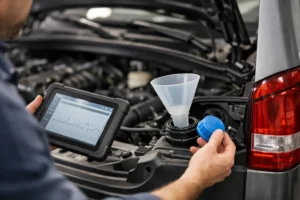
Before agreeing to a regeneration, clean or replacement, ask what the diagnostics show. Useful checks include fault codes and freeze-frame data, calculated soot load, estimated ash load, live differential pressure at idle and under load, exhaust temperature readings, coolant temperature, EGR operation and evidence of excess oil level or fuel dilution.
It is also worth checking whether the vehicle has been using the correct low-SAPS engine oil. This oil is designed to reduce the ash that reaches the DPF. The wrong oil will not usually cause an immediate blockage, but over time it can shorten the filter’s life.
At Tech Tuning Northwest, DPF faults are diagnosed around the reason the filter loaded up, not just the dashboard message. For drivers who rely on a diesel car or van for work, that approach helps avoid spending money on a forced regeneration when the real issue is a sensor, thermostat, EGR fault or an ash-loaded filter.
A DPF does not fail simply because it has collected material. It fails when the vehicle can no longer manage that material correctly. Get the readings checked before authorising work, and you will have a far better chance of choosing the repair that actually lasts.