A warning light is not a diagnosis, but it is your diesel vehicle telling you that a system has recorded a fault or is operating outside its normal range. This diesel diagnostic warning light guide explains the lights UK drivers see most often, what may be happening behind them, and why simply clearing a code rarely fixes the underlying problem.
For a commuter car, work van or family SUV, the difference matters. Ignoring an emissions warning can turn a minor sensor or driving-cycle issue into reduced power, a blocked DPF, or an AdBlue no-start countdown. Equally, replacing the part named in a generic code without testing it can be an expensive guess.
What warning-light colours usually mean
Dashboard symbols vary between manufacturers, but the colour gives a useful first indication of urgency. A red warning normally means stop as soon as it is safe to do so and check the handbook or arrange recovery. Continued driving may cause damage or create a safety issue.
An amber or yellow warning means the vehicle has detected a fault that needs attention, but it does not always mean you must stop immediately. The engine may still run normally, or it may enter reduced-power mode to protect itself and limit emissions. A flashing engine management light is more urgent than one that stays on constantly, particularly if the engine is misfiring, smoking heavily or losing power.
The symbol alone is only part of the picture. A DPF light, for example, can mean the filter needs a successful regeneration, but it can also appear because a pressure sensor, temperature sensor, EGR fault or injector issue is preventing regeneration from completing.
Engine management light on a diesel
The engine management light is usually an outline of an engine. It is the broadest warning on this guide because it can cover combustion, air intake, fuel pressure, exhaust after-treatment and electrical faults. On modern diesels, emissions-related faults are among the most common reasons it appears.
You may notice no change in how the vehicle drives, or you may have sluggish acceleration, poor fuel economy, limp mode, smoke, rough running or repeated cooling-fan operation after a journey. Reading fault codes is the starting point, not the final answer. A code tells a technician which system has detected an abnormal reading. It does not automatically prove which component has failed.
For example, an EGR flow code such as P0401 may point towards insufficient exhaust-gas recirculation. The cause could be carbon build-up in the valve or cooler, a split vacuum line on older systems, a wiring fault, an intake restriction or a sensor reading that does not make sense. Proper diagnosis checks live data and the system’s operation before parts are fitted.
Reduced power or limp mode
When the engine management light is joined by a message such as “Engine fault”, “Emission control fault” or “Power limited”, the ECU may have placed the vehicle in limp mode. This limits torque to prevent further problems and keep emissions within control where possible.
Limp mode can occur with DPF restriction, turbo boost deviations, EGR faults, low AdBlue pressure or implausible NOx sensor readings. It is often possible to drive gently to a safe location, but repeatedly forcing the vehicle through the fault can make diagnosis harder and, in some cases, increase the repair bill.
DPF warning light: regeneration or a genuine fault?
The diesel particulate filter captures soot from the exhaust. To clear that soot, the vehicle raises exhaust temperature during a process called regeneration. A DPF warning light commonly appears when soot loading has risen because regeneration has not completed.
Short, low-speed journeys are a frequent contributor, especially on diesel cars that rarely get a sustained run. If the handbook permits it and there are no other warning lights or drivability problems, a steady drive at normal road speeds may allow an active regeneration to finish. The exact conditions vary by vehicle, so do not assume a fast drive will cure every DPF warning.
If the light remains on, returns quickly, or is accompanied by an engine management light, reduced power or a glow plug warning, the issue needs checking. Possible causes include:
- A DPF that is overloaded with soot or ash
- Failed differential pressure or exhaust temperature sensors
- An EGR fault creating excess soot
- Injector, boost or air-intake faults affecting combustion
- Interrupted regenerations caused by unsuitable driving patterns
A forced regeneration is not a universal repair. It may be appropriate once the cause is understood and soot loading is within safe limits. If the filter is heavily blocked, physically damaged or full of non-combustible ash, professional cleaning or replacement may be the sensible option. Forcing a regeneration through a fault can create excessive exhaust temperatures and cause further damage.
AdBlue and SCR warnings: do not ignore the countdown
Many Euro 6 diesels use AdBlue and selective catalytic reduction, known as SCR, to reduce nitrogen oxide emissions. A warning may say “AdBlue”, “UREA”, “Emissions fault”, “No engine start in X miles”, or show an amber exhaust-related symbol. These messages are commonly misunderstood.
A low-AdBlue warning may genuinely mean the tank needs topping up with the correct fluid. However, an emissions warning or no-start countdown is often not solved by adding more fluid. The system monitors fluid quality, tank level, pump pressure, heater operation, injector performance and NOx sensor readings. If it cannot confirm that the SCR system is working, the ECU may start a countdown and eventually prevent the engine restarting.
Common fault codes include P20E8 for low reductant pressure, P204F for an SCR system performance problem, and NOx sensor-related codes such as P2201. These can affect Volkswagen Group, Mercedes-Benz, BMW, Peugeot, Citroen, Ford, Vauxhall and many other diesel vehicles, although the precise wording and failure patterns differ.
Do not wait until the countdown reaches zero. Once the no-start condition is active, the vehicle may need repair and a successful reset procedure before it will start again. Filling the tank after the fault has progressed may not remove the message.
Why AdBlue faults can be expensive to guess at
AdBlue crystallises when it dries, and contamination, wiring faults, pump problems and failed sensors can all produce similar dashboard messages. Some vehicles package several components inside the AdBlue tank, which can make replacement quotes look alarming. Before authorising a costly repair, the system should be scanned with suitable diagnostic equipment, checked against live readings and tested for known wiring, pressure and sensor faults.
Glow plug and coil warning lights
On many diesels, a coil-shaped symbol lights briefly before starting. That is normal pre-heating. If it stays on, flashes while driving, or appears with reduced power, it can indicate more than failed glow plugs.
On some Volkswagen, Audi, SEAT and Skoda diesels, a flashing glow plug light can be used as a general engine-management warning. Brake light switch faults, EGR problems, turbo control issues and DPF-related faults have all triggered it. The vehicle needs code reading and testing rather than a blind set of glow plugs.
EGR warning signs and what causes them
The EGR system feeds a controlled amount of exhaust gas back into the intake under certain conditions. This reduces nitrogen oxide emissions, but soot and oil vapour can build up over time. EGR faults may bring on the engine light, cause hesitation, uneven idle, smoke, poor economy or DPF regeneration problems.
A valve may be clogged, stuck open or stuck closed. There may also be a problem with its actuator, position sensor, cooler, pipework or wiring. The right repair depends on the fault found. Cleaning can help where carbon build-up is the issue and the component is otherwise sound; it will not cure an electrical failure or damaged actuator.
What to do when a diesel warning appears
First, take note of the exact message, warning symbols and any change in how the vehicle drives. Avoid repeatedly clearing codes with a basic reader. Clearing the light can erase useful freeze-frame information and may allow a fault to worsen before it is investigated.
If the vehicle has a red warning, severe loss of power, overheating, excessive smoke or a no-start countdown close to zero, treat it as urgent. For an amber DPF warning with no other symptoms, check the handbook before attempting a suitable drive cycle. For AdBlue and engine-management messages, arrange diagnosis sooner rather than later, particularly if a countdown is displayed.
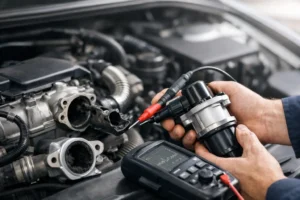
A worthwhile diagnostic process includes a full vehicle scan, confirmation of stored and pending codes, live-data checks, visual inspection where relevant, and testing of the suspected circuit or component. It should also consider related faults. A DPF code may be the result of an EGR issue; a NOx code may be caused by an SCR dosing fault rather than the sensor itself.
For drivers in Greater Manchester who need this checked without losing a day at a garage, Tech Tuning Northwest provides specialist mobile diesel diagnostics for emissions and ECU faults. The aim is to identify why the warning appeared before recommending cleaning, repair, replacement or software work.
The sensible next step is not to fear every amber light or ignore it until the vehicle stops. Record what the dashboard says, notice the symptoms, and have the system diagnosed while there is still a choice of repair options.