A dashboard message saying “AdBlue fault” can feel urgent, particularly when it is followed by a mileage countdown or an engine-start warning. AdBlue fault codes explained properly means looking beyond the wording on the dash. The code is a clue to what the engine ECU has detected, not automatic proof that one expensive part has failed.
On modern diesel cars and vans, the AdBlue system works alongside the selective catalytic reduction system, usually called SCR. It injects a measured amount of AdBlue fluid into the exhaust to reduce harmful NOx emissions. If the system cannot confirm that it is dosing correctly or reducing emissions as expected, it stores a fault code and may eventually prevent the engine from restarting.
Why an AdBlue warning can lead to a no-start countdown
Manufacturers are required to ensure the SCR system remains operational. That is why a relatively minor issue, such as a sensor signal outside its expected range, can trigger messages such as “No engine start possible in 650 miles” or “Start engine not possible”. The vehicle will normally continue to drive during the countdown, but once it reaches zero and the engine is switched off, it may not restart.
The key point is that adding more AdBlue does not necessarily clear this warning. If the tank is genuinely low, a correct top-up may resolve a low-level message after the vehicle has recognised it. If there is a stored SCR fault, however, the ECU still needs evidence that the system is working correctly. Clearing a code without fixing the cause commonly sees the warning return within a few journeys.
AdBlue fault codes explained by system area
Fault-code formats vary between manufacturers and diagnostic tools. Some show a standard P-code, while others display a manufacturer-specific code with more detail. The exact description matters, but most AdBlue and SCR faults fall into a handful of system areas.
AdBlue quality, level and temperature faults
Codes relating to AdBlue quality do not always mean somebody has put the wrong fluid in the tank. The system may infer poor quality because it cannot achieve the expected NOx reduction, because a level sensor is reading incorrectly, or because crystallisation has affected part of the tank unit.
AdBlue is a precise urea and demineralised-water solution. Contaminated fluid, old fluid stored incorrectly, or topping up from an unsuitable container can cause problems. More often, particularly on vehicles that do lots of short runs, the issue is within the tank assembly. Many tanks contain the pump, heater, level sensing and control electronics as one unit, so a single internal fault can produce several related codes.
Temperature and heater faults are also common. AdBlue can freeze in cold conditions, and the system is designed to thaw it when needed. A failed heater circuit, damaged wiring or an internal tank fault may stop that process and trigger an SCR warning. The vehicle is not usually objecting to cold weather itself – it is reporting that the heating system is not responding as it should.
AdBlue pressure and injector faults
The AdBlue pump has to build sufficient pressure before fluid can be injected into the exhaust. A code such as P20E8, often described as reductant pressure too low, points towards a pressure problem. That could be a weak pump, a leak, a restriction, a blocked filter where fitted, wiring trouble, or crystallised deposits in the pipework or injector.
The injector is mounted in the exhaust and operates in a harsh environment. White crystal deposits around the injector or pipe connection are a useful visual clue, but they are not the full diagnosis. The deposit may be the result of a leaking injector, poor spray pattern, failed line connection or a pressure-control issue elsewhere in the system.
A technician should test commanded pump operation, live pressure readings and the injector circuit before condemning a tank or injector. Replacing parts based on one generic code is how owners end up paying twice.
NOx sensor faults
NOx sensors measure nitrogen oxide levels before and after the SCR catalyst. The ECU uses their readings to judge whether the system is reducing emissions effectively. Codes such as P2201, commonly associated with NOx sensor range or performance, may identify the upstream sensor, downstream sensor, its heater, wiring or signal plausibility.
A failed NOx sensor is a frequent cause of AdBlue warnings on European diesel vehicles, including many Volkswagen Group, BMW, Mercedes-Benz, Peugeot, Citroën, Ford and Vauxhall models. However, a NOx-related code does not always mean the sensor itself is faulty. Low AdBlue pressure, an injector issue, exhaust leaks, damaged wiring or a worn SCR catalyst can all produce readings the ECU considers implausible.
This is where live data matters. Comparing both sensor values, exhaust temperatures, calculated dosing demand and system pressure gives a far clearer picture than reading the code description alone.
SCR efficiency faults
Codes such as P20EE are often described as SCR NOx catalyst efficiency below threshold. This sounds as though the catalytic converter has failed, and sometimes it has. But it is a result-based code: the ECU believes emissions are not being reduced enough. It does not tell you why.
Before considering an SCR catalyst, a proper diagnosis needs to rule out poor dosing, poor-quality fluid, a blocked or leaking injector, inaccurate NOx sensors and exhaust leaks. On some vehicles, software updates and adaptation procedures also form part of a correct repair. Fitting a costly catalyst without testing the rest of the system is a gamble, not a diagnosis.
What the code number does – and does not – tell you
A fault code identifies the circuit, component group or operating condition that fell outside the ECU’s limits. It does not reliably identify the failed component. For example, “reductant pump control circuit” may be caused by the pump, a fuse, corroded connector, damaged loom, control module or low battery voltage.
Freeze-frame data is useful because it records conditions when the fault occurred, such as engine temperature, vehicle mileage, voltage and dosing pressure. A fault that appears only after a motorway run may need a different line of investigation from one that returns immediately after ignition is switched on.
The same applies to intermittent faults. A warning that disappears for a week is not necessarily fixed. It may simply need a particular temperature, vibration level or journey condition to return. Avoid repeatedly clearing it and hoping for the best, especially if a start countdown is active.
Common symptoms drivers notice first
The first sign may be an amber engine management light, an AdBlue or emissions warning, or a message asking for a top-up even though the tank has been filled. Some vehicles enter reduced-power mode, although many remain perfectly driveable until the fault becomes more serious.
Other signs include an inaccurate AdBlue range display, a fan running after the engine is switched off, white crystals around the exhaust injector area, or a countdown that keeps falling despite a full tank. A sudden no-start warning after an AdBlue top-up is particularly frustrating, but it usually indicates that an existing stored fault has not been resolved rather than that the top-up caused the issue.
What to do when an AdBlue fault appears
First, read the exact dashboard message and take a photograph if possible. Check whether it is a simple low-level prompt or a fault warning with a remaining-mileage countdown. If the level is low, use fresh AdBlue that meets the required specification and avoid overfilling the tank.
Do not pour water, additives or any improvised fluid into the AdBlue tank. Do not ignore a countdown, either. Book diagnosis while there is still time to drive the vehicle, rather than waiting until it will not restart outside home or work.
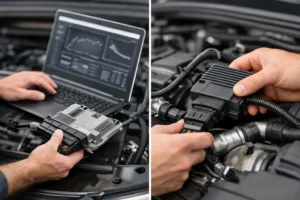
A suitable diagnostic process should include a full module scan, fault-code history, live data, electrical checks and inspection of the tank, lines, injector and connectors where accessible. Depending on the code, it may also require pressure testing, injector tests and checks of NOx sensor behaviour. The repair might be straightforward, but it should be based on test results.
When specialist diagnosis saves money
AdBlue systems can be expensive when parts are replaced unnecessarily. Main dealer quotations often default to large assemblies, while cheaper garages may fit a sensor or clear a code without proving the cause. There are occasions when a tank, pump, injector, NOx sensor or catalyst genuinely needs replacement, but there should be evidence behind that decision.
For drivers across Greater Manchester dealing with a warning, countdown or repeated SCR fault, Tech Tuning Northwest carries out hands-on diesel diagnostics and can assess many faults at your home or workplace. The aim is to identify the actual failure, explain the options plainly and avoid charging for parts that will not solve the problem.
If your vehicle still starts, treat the warning as time to diagnose it properly rather than time to panic. A clear code description, the right tests and an honest assessment usually make an AdBlue fault far more manageable than the dashboard message first suggests.