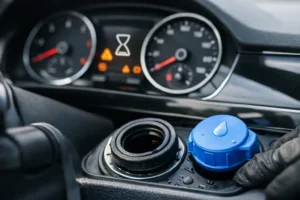
A dashboard message such as “AdBlue system fault”, “emissions fault” or “no engine start in 700 miles” is often the first sign of SCR faults. For many drivers, the vehicle can still be used at first, which makes it tempting to put off the repair. That can be an expensive mistake once the countdown reaches zero and the engine will not restart.
SCR issues are common on modern diesel cars and vans, particularly vehicles used for short journeys, stop-start work or irregular mileage. The warning is not always caused by an empty AdBlue tank, and topping it up without diagnosis can leave the real problem untouched.
What is an SCR system?
SCR stands for Selective Catalytic Reduction. It is the emissions system used on many Euro 6 diesel vehicles to reduce harmful nitrogen oxide emissions, usually referred to as NOx.
The system injects a measured amount of AdBlue into the exhaust. AdBlue is a mixture of purified water and urea. When it is injected at the correct time and in the correct quantity, it reacts inside the SCR catalyst and turns NOx into nitrogen and water vapour.
For this to work, several parts need to agree with each other. The engine ECU needs accurate information from NOx sensors and exhaust temperature sensors. The AdBlue tank, pump, heater, lines and injector must operate correctly. The SCR catalyst also needs to be capable of doing its job. If the ECU sees a result outside its expected limits, it records a fault and may begin a no-start countdown.
That is why an SCR warning can be more complicated than a simple low-fluid alert. The dashboard message tells you the emissions system has failed a check. It does not identify the failed component.
Common SCR fault symptoms
The exact wording varies between manufacturers, but the symptoms are familiar across Volkswagen Group, BMW, Mercedes-Benz, Peugeot, Citroën, Ford, Jaguar Land Rover, Renault and many other diesel vehicles.
You may see an engine management light, an AdBlue warning, an emissions-system message or a separate amber warning symbol. Some vehicles display the remaining distance before starting is disabled. Others may show reduced engine performance or enter limp mode, although this is not present with every SCR issue.
The most urgent symptom is a no-start message. It normally means the vehicle has detected an emissions fault serious enough that it must prevent a future engine start if the fault remains unresolved. It does not usually cut the engine out while driving, but once the ignition is switched off after the countdown reaches zero, the vehicle may refuse to start.
A poor-running engine is not automatically an SCR fault. DPF, EGR, boost-control and fuel-system problems can all trigger similar engine warning lights. Proper diagnosis matters because replacing parts based on a dashboard message alone is how bills quickly get out of hand.
Why SCR faults happen
AdBlue quality, level and crystallisation
Low AdBlue level is the simplest cause, but it is not the only one. The system can also object to contaminated, old or incorrect fluid. AdBlue should be kept clean and should only be filled from a suitable sealed container. Water, diesel contamination or additives can cause readings and dosing performance to fall outside specification.
Crystallisation is another regular problem. When AdBlue dries around the injector, pipe connections or tank fittings, it leaves white crystals behind. Small deposits can obstruct the injector spray pattern; heavier deposits can damage seals, lines and electrical connectors. This is especially common where a small leak has been present for some time.
Failed NOx sensors
NOx sensors are among the most common causes of SCR-related fault codes. Most systems use one sensor before the SCR catalyst and another after it. Their readings allow the ECU to assess both engine-out NOx and how effectively the catalyst is reducing it.
A sensor may fail internally, suffer wiring damage, develop connector corrosion or give implausible readings once hot. A failed downstream sensor can make a healthy SCR catalyst look inefficient. Conversely, a genuine dosing issue can make a sensor code appear alongside the main fault. Reading the code is only the starting point – live data is needed to see whether the readings make sense.
AdBlue tank, pump and heater faults
Many vehicles have an AdBlue supply module built into the tank. Depending on the design, it may include the pump, level sensor, temperature sensor, heater and control electronics. This packaging can make a relatively small internal failure costly if the manufacturer only supplies parts as a complete tank assembly.
Heater faults are particularly common in colder weather because AdBlue freezes at around -11°C. The system is designed to thaw it when needed, but a failed heater or temperature reading can trigger faults even if the tank contains plenty of fluid.
The pump also has to build and hold the specified pressure. If it cannot do so, the ECU may log pressure, delivery or dosing faults. A technician needs to test commanded operation and pressure behaviour rather than assuming that a tank fault code means the entire tank must be replaced.
Injector and pipework problems
The AdBlue injector sits in a harsh part of the exhaust system. It can become blocked with crystallised fluid, leak, seize in place or fail electrically. Pipes can crack, chafe or become blocked. A leak may be obvious from white crystal build-up, but not always.
The key question is whether the injector is delivering the correct dose and spray pattern. Fitting a new injector without checking pipework, supply pressure and electrical control can lead to the same warning returning.
SCR catalyst efficiency faults
An SCR catalyst fault does not automatically mean the catalyst itself has failed. The ECU often reaches that conclusion after comparing NOx sensor readings and seeing insufficient reduction. Incorrect AdBlue dosing, sensor inaccuracies, exhaust leaks or an engine producing excessive NOx can all create the same result.
The catalyst may genuinely be degraded or contaminated, especially on higher-mileage vehicles. But it should be treated as a diagnosis to prove, not the first part to replace. This is one area where poor diagnosis can result in a four-figure bill for no improvement.
How SCR faults should be diagnosed
A proper assessment starts with a full diagnostic scan, not just the first generic code read from a basic reader. Stored, pending and manufacturer-specific fault codes should be checked alongside freeze-frame information showing the conditions when the fault occurred.
The next stage is live data. This can include AdBlue level and quality readings, tank temperature, pump pressure, requested and actual dosing information, exhaust temperatures, and upstream and downstream NOx values. Readings need interpreting in context. A value that looks unusual at idle may be normal during a cold start, and a sensor that appears plausible in the driveway may fail under load.
A visual inspection is equally useful. White crystals around the injector or tank area, damaged wiring, fluid leaks and exhaust leaks can point to the root cause quickly. Where the diagnostic routine supports it, the technician may run component activation tests, pressure checks or guided tests.
After the physical repair, many vehicles need fault memories cleared and a reset, adaptation or relearn procedure completed. Simply clearing the warning without fixing the underlying problem may temporarily remove the message, but the ECU will normally run its checks again and bring it back. If a no-start countdown is active, it may not cancel until the repair and relevant reset procedure have been completed correctly.
Can you drive with an SCR fault?
It depends on the message and how the vehicle is behaving. If there is no red warning, no severe loss of power and the vehicle is driving normally, there may be time to arrange diagnosis. However, a no-start countdown should be treated as a deadline, not a suggestion. Avoid unnecessary journeys and do not wait until the remaining mileage is nearly gone.
Do not keep adding AdBlue repeatedly if the tank already has enough in it. Overfilling can create further problems, and it will not fix a faulty sensor, pump or injector. Equally, do not rely on a code clear as a repair. An intermittent issue can become permanent at the most inconvenient moment, particularly for van owners who need the vehicle for work.
Getting the right SCR repair
The best repair is the one supported by test results. That may be cleaning crystallised deposits and repairing a connector, replacing a NOx sensor, repairing pipework, fitting an injector or addressing a tank module fault. In some cases, the SCR catalyst is the correct answer, but it should not be guessed at.
For drivers in Greater Manchester dealing with an AdBlue warning or active countdown, Tech Tuning Northwest carries out specialist diesel diagnostics at home or work where suitable. The aim is to identify the failed part and confirm the repair, rather than sell a list of expensive possibilities.
An SCR warning is manageable when it is diagnosed early. Treat the message seriously, keep the fault information intact, and get the system tested before a warning light turns into a vehicle that will not restart.