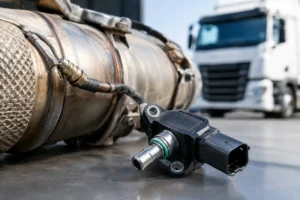
A DPF sensor versus hose blockage fault is one of the easiest diesel problems to misdiagnose. Both can bring on an engine management light, a DPF warning, reduced power and failed regeneration attempts. Yet replacing a perfectly good sensor when a pressure hose is blocked with soot is an expensive mistake – particularly when the vehicle is needed for work.
The answer is not to guess from a fault code alone. A proper diagnosis has to look at what the DPF pressure sensor is reporting, whether exhaust pressure can actually reach it through both hoses, and whether the readings make sense with the engine off, idling and under load.
What the DPF pressure sensor actually does
Most modern diesel cars and vans use a differential pressure sensor to monitor the exhaust pressure before and after the diesel particulate filter. It is usually connected to the exhaust by two small pipes or hoses. One takes a reading upstream of the DPF, where pressure is higher; the other reads downstream, where pressure should be lower.
The engine ECU compares those readings to calculate the pressure difference across the filter. As soot builds up in the DPF, the difference increases. That information helps the ECU decide when to start an active regeneration and whether the filter is becoming too restricted.
This is why a sensor fault and a blocked hose can look so similar. If the sensor receives an inaccurate signal, the ECU may believe the DPF is blocked. If a hose is restricted, split, disconnected or full of soot and moisture, the sensor cannot receive a true pressure reading either.
On many European diesel vehicles, this setup is found on BMW, Mercedes, Volkswagen Group, Ford, Peugeot, Citroen, Renault, Vauxhall and Fiat-based vans. The exact sensor location differs, but the diagnostic principle is the same.
DPF sensor versus hose blockage: the key differences
A failed differential pressure sensor is an electrical or internal sensor issue. It may have a supply, earth or signal problem, or it may simply report a value that does not match the real exhaust pressure. A hose blockage is a physical restriction in one or both pressure pipes, or in the small exhaust take-off points where those pipes connect.
A sensor can fail suddenly. A hose blockage often develops over time as soot, carbon deposits and condensation build up. Short journeys, incomplete regenerations and repeated stop-start use can make this more likely, especially on vans that spend long periods idling or working locally.
Neither fault has one guaranteed symptom. However, the live data often tells a clearer story than the dashboard warning light.
Signs that point towards a pressure sensor fault
With the ignition on and engine off, DPF differential pressure should normally be close to zero. A small variation may be acceptable depending on the system, but a large positive or negative reading before the engine has started is suspicious.
An implausible fixed reading is another warning sign. For example, if the pressure value remains exactly the same at idle and when the engine speed is raised, the sensor may not be responding. The wiring, connector and reference voltage still need checking before condemning the sensor itself.
Some vehicles will store faults that specifically refer to DPF pressure sensor circuit range, signal plausibility, voltage too high or voltage too low. These codes are useful clues, but they do not prove the sensor has failed. A restricted hose can still cause an implausible signal fault because the ECU sees pressure behaviour it does not expect.
Signs that point towards blocked or damaged hoses
A blocked upstream hose commonly causes the sensor to under-read pressure. The ECU may think the DPF is cleaner than it really is, allowing soot loading to rise without taking the right action. In other cases, a partially blocked hose can create slow, erratic readings that cause repeated regeneration faults.
A blocked downstream hose, a split hose or a loose connection can have a different effect, depending on the system. The pressure difference may appear too high, too low or inconsistent. Heat can make rubber hoses brittle, while metal pipes can corrode or become choked at the exhaust connection.
Physical inspection matters here. The hoses should be removed carefully and checked end to end, not just glanced at from above. The small ports in the exhaust pipes also need attention. It is quite common to find the hose clear but the take-off port packed solid with carbon.
Why fault codes are only the starting point
A code reader may show a DPF differential pressure fault and lead a garage to quote for a new sensor. That is not necessarily bad advice, but it is incomplete if the hoses, ports and live readings have not been checked.
The same applies to codes suggesting excessive soot loading or unsuccessful regeneration. The DPF may genuinely contain too much soot, but the root cause might be false pressure information. Replacing or cleaning the filter without correcting the sensor circuit or blocked hose can leave the warning light returning soon afterwards.
A sound diagnosis considers the full picture: calculated soot mass, ash load where available, differential pressure at idle, pressure at raised engine speed, exhaust temperature sensor readings, regeneration history and any related EGR, boost or fuel-system faults. A DPF problem is often the result of another fault rather than the first failure.
How a proper diagnosis is carried out
The first check is a full diagnostic scan, not just the headline fault code. Freeze-frame data can show the engine conditions when the fault was logged, while live data reveals whether the reported DPF pressure is believable.
With the engine switched off, the sensor reading should be checked against atmospheric pressure expectations. With the engine running, pressure should rise in a sensible, progressive way as engine speed increases. A technician may compare readings with a known-good pressure gauge where necessary, rather than relying solely on the ECU value.
The pressure sensor hoses and their exhaust take-off points are then inspected for soot blockage, kinks, cracking, heat damage and poor connections. Electrical checks should include the connector condition, wiring integrity, power supply, earth and signal output. On some vehicles, the sensor also needs resetting or adaptation after replacement so the ECU can interpret the new component correctly.
Only after these checks is it sensible to decide whether the DPF needs cleaning, whether a regeneration is safe, or whether the real repair is a sensor, pipe or wiring fault.
Do not force a regeneration too early
A forced regeneration can be useful when the DPF has a manageable soot load and the underlying cause has been fixed. It is not a cure for a faulty pressure reading, blocked hoses, exhaust temperature sensor faults or an engine that is producing excessive soot.
Forcing a regeneration on a badly loaded filter can create very high exhaust temperatures. If the sensor data is wrong, the ECU may not manage the process as intended. In the worst cases, this can damage the DPF or expose an existing fault elsewhere in the exhaust system.
There is also a difference between soot and ash. Regeneration burns soot away, but it does not remove ash left behind from normal engine oil additives and long-term use. A high ash-loaded DPF may need professional cleaning or replacement even if all sensor and hose faults are corrected.
Common causes that are missed
The differential pressure sensor and its hoses deserve attention, but they are not the only causes of DPF warnings. Frequent short trips prevent normal regeneration from completing. A thermostat fault can stop the engine reaching proper operating temperature. EGR faults, boost leaks, injector problems and air-flow issues can increase soot production.
On vehicles with AdBlue and SCR systems, separate emissions faults can also complicate the picture. They do not usually create a DPF pressure fault directly, but multiple warning lights can make it tempting to treat every code as one problem. Each system should be tested on its own evidence.
For working vans, payload, idling time and journey pattern matter. A van doing local calls around Greater Manchester may have little opportunity to complete a motorway-speed regeneration, even though it is driven all day. That does not automatically mean the DPF has failed, but it does mean the fault needs resolving before the vehicle is pushed into limp mode or a no-start situation develops from another emissions issue.
Repairing the fault without wasting money
If a hose or exhaust pressure port is blocked, cleaning or replacing the affected parts may restore accurate readings at a fraction of the cost of a DPF replacement. If the sensor is electrically faulty or gives implausible readings after the hoses are proven clear, replacement is normally straightforward – provided the correct part and any required calibration are used.
If the DPF is genuinely restricted, the repair depends on soot level, ash level, vehicle condition and why the filter loaded up. A controlled regeneration may be appropriate in some cases. In others, off-car DPF cleaning is the sensible option. A technician should be able to explain why one route suits your vehicle rather than simply selling the most expensive repair.
At Tech Tuning Northwest, diagnostics are approached in that order: establish what the vehicle is reporting, verify the physical system, then repair the actual cause. For owners who cannot lose a working day to a garage visit, mobile diagnosis can make that process far less disruptive.
A DPF warning light is a reason to investigate, not a reason to throw parts at the car. Get the pressure readings and hoses checked properly before agreeing to a sensor, a forced regeneration or a replacement DPF.