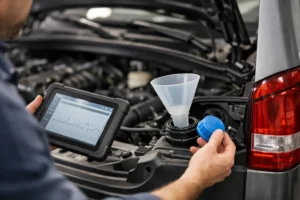
A P20E8 fault code is usually the point where an AdBlue problem becomes more than an occasional warning light. Your vehicle has detected that pressure in the diesel exhaust fluid, or AdBlue, supply system is below the level needed for reliable SCR emissions control. Depending on the vehicle, that can lead to an engine warning light, an AdBlue warning, reduced performance or a countdown stating that the engine will not restart after a set mileage.
That does not automatically mean the AdBlue tank needs replacing. On many diesel cars and vans, several components can cause the same code. Replacing expensive parts based on the code alone is how owners end up paying twice.
What the P20E8 fault code actually means
P20E8 is a generic diagnostic trouble code commonly described as reductant pressure too low. “Reductant” is the technical name used for AdBlue in the fault-code system. The vehicle’s SCR system needs to inject a measured amount of AdBlue into the exhaust, where it helps reduce harmful nitrogen oxides.
To do that accurately, the system must build and maintain pressure between the tank, pump, supply line and AdBlue injector. If the ECU commands the pump to run but sees pressure that is too low, too slow to build or unable to hold, it records P20E8.
The exact wording, pressure target and parts layout vary between manufacturers. You may see this fault on Volkswagen Group diesels, Mercedes-Benz cars and vans, BMW, Peugeot, Citroen, Ford, Jaguar Land Rover and other Euro 6 diesel vehicles. The code tells us there is a pressure problem. It does not, by itself, prove whether the fault lies in the pump, line, injector, wiring or pressure sensor.
What symptoms will you notice?
The first sign may simply be an engine management light with an AdBlue or emissions-system message. Some drivers notice nothing different at first, particularly if the pressure is only occasionally dropping below target.
As the fault becomes more consistent, messages may warn of an emissions fault or state a limited number of miles until no engine restart is possible. On certain vehicles, the countdown starts even when the AdBlue tank is full. That is because the vehicle is concerned with whether it can dose AdBlue correctly, not just whether fluid is present.
You may also see reduced power on some models, although P20E8 does not always cause limp mode. A cold-weather pattern can be useful evidence too. If the warning appears after freezing temperatures and then clears, the tank heater or thawing process may be relevant. If it appears in all conditions, a delivery, electrical or sensor fault is more likely.
Why AdBlue pressure becomes too low
A failing pump or tank module
Many modern systems have the pump, pressure sensor, heater and control electronics built into the AdBlue tank assembly. This makes the system compact, but it can make a single failed internal component expensive to replace through the main dealer route.
A worn pump may run but fail to create enough pressure. An internal leak or a faulty pressure sensor can produce a similar reading. On some vehicles, the pump can be heard priming when the ignition is switched on, but noise alone is not proof that it is working properly.
Crystallised or blocked AdBlue components
AdBlue can crystallise into a white residue when it dries around connections, injectors or tank fittings. Small leaks are particularly troublesome because the liquid evaporates and leaves crystals behind. Over time, those deposits can restrict flow, prevent a valve from seating properly or damage connectors.
A blocked AdBlue injector at the exhaust pipe can also affect the system, especially if deposits have built up around its tip. It is not always the direct cause of a low-pressure code, but it needs inspection as part of a proper diagnosis.
Leaking, damaged or restricted lines
The pressure line between the tank and injector is exposed underneath the vehicle. A damaged line, poor connection, leak or restriction means the pump may be working harder without reaching its target pressure. Rodent damage, impact damage and corrosion around connectors can all be factors on older or high-mileage vehicles.
Because some lines are heated, wiring damage can also be mistaken for a purely mechanical fault. A visual inspection matters, but it needs to be backed up with live diagnostic data.
Electrical faults and poor connections
A weak supply voltage, blown fuse, corroded connector or damaged wiring can stop the pump operating at full output. Water ingress around the tank connector is a familiar issue on vehicles that cover regular motorway miles in all weather.
The ECU may record additional codes for pump control, heater circuits, communication or pressure-sensor plausibility. These supporting codes are often more useful than P20E8 alone. Clearing them without investigating the cause only removes evidence temporarily.
Contaminated or unsuitable fluid
AdBlue should meet the correct ISO 22241 specification. Contamination from an unclean container, topping up with the wrong liquid or using old fluid that has been stored badly can create problems within the tank and dosing system.
Do not assume every P20E8 fault is caused by poor-quality AdBlue, though. It is a possible cause, not a diagnosis. Fresh, correctly stored fluid will not repair a failing pump, damaged wiring or a leaking supply line.
Can you keep driving with P20E8?
If the vehicle is driving normally and there is no restart countdown, it may be possible to make essential short journeys. However, leaving it for weeks is risky. A minor pressure issue can become a non-start situation once the SCR system reaches its restart inhibit threshold.
Do not keep topping up the tank in the hope that the warning will disappear if the level is already adequate. Overfilling creates its own problems and does not restore pressure. Likewise, repeatedly clearing the code with a basic reader may delay a proper repair but will not stop the ECU seeing the fault again.
If there is a “no engine restart in” message, treat it as urgent. Once the counter reaches zero, many vehicles will crank but refuse to start until the underlying SCR fault is repaired and the system has completed the required checks.
How P20E8 should be diagnosed
A worthwhile diagnosis starts with a full scan of the engine and SCR-related modules, not just a readout of the first code found. The technician should check stored, pending and manufacturer-specific faults, along with freeze-frame information showing the conditions when P20E8 was logged.
Live data is the next key step. This allows comparison between the requested pressure and the actual pressure, while checking whether the pump is being commanded on. A pressure reading that never rises points in a different direction from one that rises briefly then falls away.
The physical system then needs checking for crystal deposits, leaks, damaged lines, connector corrosion and signs of impact. Electrical testing can confirm power, earth and wiring integrity before an expensive tank module is condemned. Where suitable for the vehicle, controlled actuator tests and dosing tests can help confirm operation.
This approach takes longer than guessing from a code, but it is normally cheaper than fitting a pump, injector or sensor that was never faulty. It also matters because P20E8 can appear alongside NOx sensor or SCR efficiency faults. Those may be related, or they may be separate problems that need resolving in the right order.
Repair options depend on the real cause
A repair may be as straightforward as correcting wiring damage, replacing a leaking line or cleaning and renewing a restricted injector. In other cases, the tank pump module or a pressure-sensing component genuinely has failed and requires replacement.
Software checks can also be relevant. The ECU must be assessed for stored faults, adaptations and any manufacturer-required reset procedures after a repair. A reset is not a repair in itself, but some systems will not recognise a successful repair until the correct test routine has been completed.
For drivers in Greater Manchester dealing with a P20E8 warning or a restart countdown, Tech Tuning Northwest can carry out specialist diesel emissions diagnostics at home or work where appropriate. The priority should be establishing why the pressure is low before approving parts, particularly when a previous garage has suggested replacing the complete AdBlue system.
If the warning has only just appeared, take a clear photo of every dashboard message, avoid repeatedly clearing the code and arrange diagnosis before the issue develops into a vehicle that will not restart. Those details can save time, parts and a great deal of disruption.